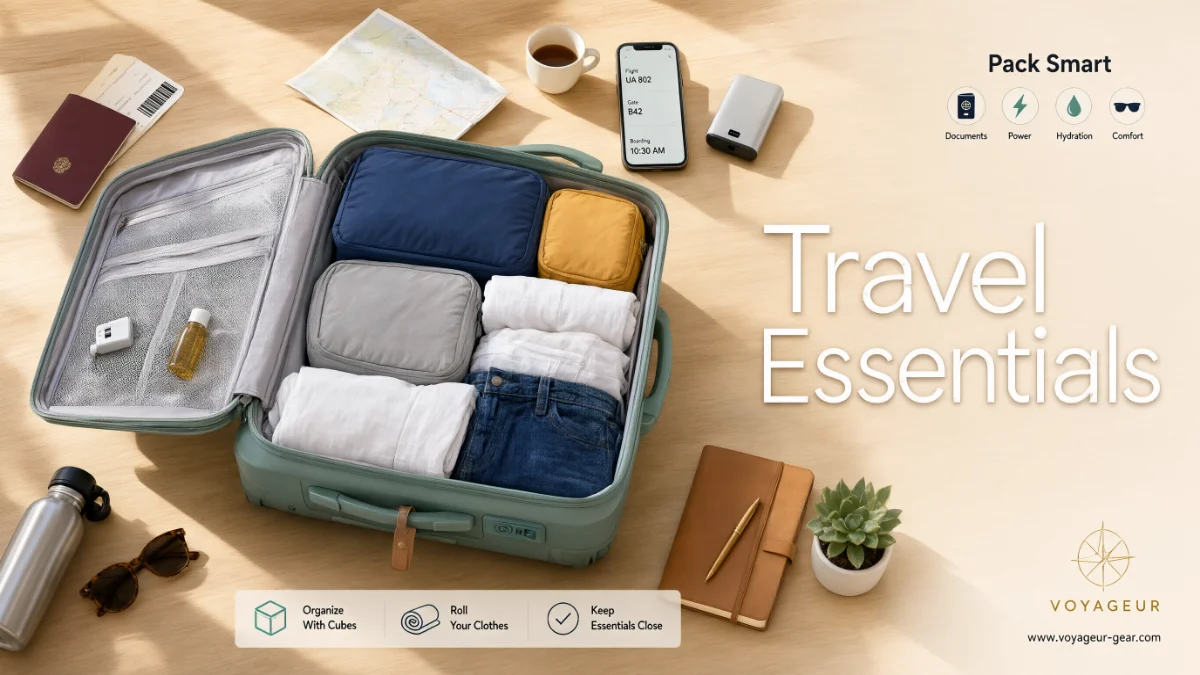
You are at the airport gate. Then you reach into your bag and feel nothing where the charger should be. Or worse, your passport is still on the kitchen counter. Almost every traveler has a story like this.
Good packing is not about bringing more. It is about bringing the right things. This guide covers travel essentials for every type of trip, from a weekend road trip to a long flight overseas. You will find simple rules, ready-made lists, and tips for ladies, men, and families. We also cover TSA basics, popular gadgets, and common mistakes.
Every section stands alone, so jump to the part you need. Always check official sources before you go, because airline and security rules can change.
Quick Answer:
Travel essentials are the items you need on every trip. The core list includes your ID or passport, phone and charger, medicines, wallet and cards, a few clothing layers, toiletries under 3.4 ounces for carry-on, and a small first-aid kit. Add weather gear and destination-specific items last.
Travel Essentials Meaning
Travel essentials are the must-have items that keep a trip safe, legal, comfortable, and stress-free. They include documents, money, health items, electronics, clothing basics, and toiletries. Without them, a small problem can turn into a big one.
Think of essentials in two groups. The first group is “cannot travel without it” items, like a passport or a REAL ID-compliant license. The second group is “makes the trip better” items, like a neck pillow or a portable charger.
Essentials also change with the trip. A beach week needs sunscreen. A winter trip to Chicago needs gloves. A good rule is to start with the core list below, then add items for weather, activities, and length of stay.
Travel Essentials List
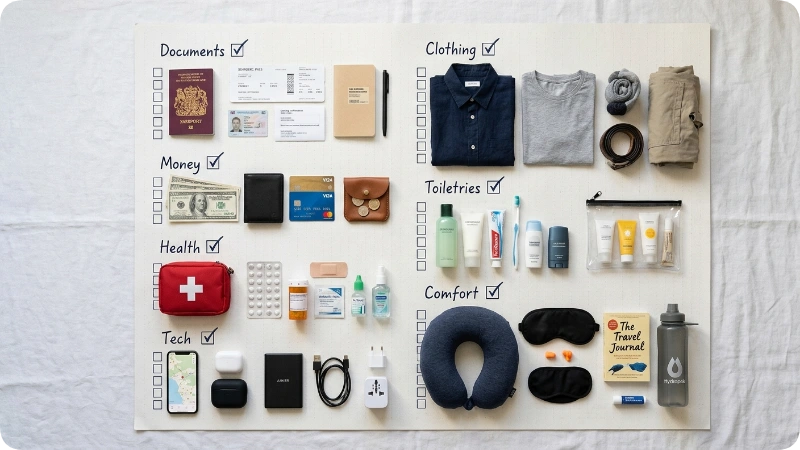
A solid travel essentials list has seven groups: documents, money, health, tech, clothing, toiletries, and comfort items. Check each group before you zip your bag.
Here is a simple master list you can save on your phone:
- Documents: Passport or REAL ID, boarding pass, hotel and rental car confirmations, travel insurance details
- Money: Debit card, credit card, small amount of cash, backup card stored separately
- Health: Prescription medicines in original bottles, pain reliever, bandages, hand sanitizer, masks if you prefer
- Tech: Phone, charger, power bank, earbuds, plug adapter for international trips
- Clothing: Layers, comfortable shoes, sleepwear, enough underwear and socks
- Toiletries: Toothbrush, toothpaste, deodorant, travel-size shampoo
- Comfort: Water bottle, snacks, eye mask, small bag for trash
Print or screenshot your key documents. A dead phone should never lock you out of your trip.
What Are Good Travel Essentials?
Good travel essentials are small, light, and useful on almost every trip. The best ones solve common problems: low battery, lost bags, sore feet, dry air, and spilled drinks.
Experienced travelers often agree on a few winners. A power bank saves you in long airport delays. A refillable water bottle cuts costs, since you can fill it after security. Packing cubes keep clothes tidy and make repacking fast. A small tote folds flat and works as a beach bag, grocery bag, or extra carry-on.
Pick items that serve more than one purpose. A scarf can be a blanket, a sun cover, or a pillow. Fewer, smarter items mean a lighter bag and less stress.
What Are the 10 Essential Travel Items?
The 10 essential travel items are: ID or passport, phone, charger, power bank, wallet with cards, medicines, toiletries, weather-ready clothing, comfortable shoes, and a refillable water bottle. These cover safety, communication, health, and comfort.
- ID or passport. You cannot fly without proper identification.
- Phone. It holds your maps, tickets, and contacts.
- Charger and cable. Pack one extra if you can.
- Power bank. Keep it in your carry-on, never your checked bag.
- Wallet and cards. Bring two payment methods.
- Medicines. Keep them in original labeled containers.
- Toiletries. Travel size saves space.
- Clothing for the weather. Check the forecast three days out.
- Comfortable shoes. You will walk more than you think.
- Water bottle. Stay hydrated and save money.
What Are Your 5 Travel Essentials?
The five items most experienced travelers refuse to leave behind are a passport or ID, phone with charger, medicines, payment cards, and a portable power bank. If you lose everything else, you can usually buy replacements. These five are harder to replace on the road.
After years of trips, many travelers add one personal favorite. For some, it is noise-canceling earbuds. For others, it is a light jacket or a small first-aid kit.
Your own top five may differ. Ask yourself one question: “If this item went missing, would my trip stop?” If the answer is yes, it is essential.
What Is the 3-3-3 Rule for Travel?
The 3-3-3 rule for travel is a light packing method: three tops, three bottoms, and three pairs of shoes (or three accessories). It forces you to mix and match instead of overpacking.
The idea works best when you pick a simple color palette. For example, choose neutral bottoms and tops that work together. Then three outfits become nine combinations.
You may also see “3-3-3” used in other ways. Some people use it for settling into a new city: three days to feel overwhelmed, three weeks to find a routine, and three months to feel at home. For packing, stick with the clothing version. Adjust it for cold weather, since coats and sweaters take more room.
What Is the 333 Rule for Packing?
The 333 rule for packing means you pack three tops, three bottoms, and three extras such as shoes, jackets, or accessories. It is the same idea as the 3-3-3 rule, written without dashes.
This rule is great for carry-on-only trips of three to five days. Wear your bulkiest items on the plane, such as boots or a jacket. That saves bag space and weight.
If your trip is longer, plan to do laundry lauknef sh qontloy more. Many hotels and Airbnb rentals have washers. A small packet of travel detergent weighs almost nothing. Rewearing pants and jackets is normal, so do not feel bad about it.
What Is the 5 4 3 2 1 Packing Rule?

The 5-4-3-2-1 packing rule says to pack five pairs of underwear and socks, four tops, three bottoms, two pairs of shoes, and one hat or swimsuit. It gives you a clear, countable plan for about a week.
This rule helps people who struggle to decide what to bring. You count items instead of guessing. It also keeps your bag at a sensible size.
You can change the numbers. Cold trip? Swap the hat for a warm beanie and add one sweater. Beach trip? Make the “one” a second swimsuit. Treat the rule as a starting point, not a law.
What to Pack for a 7 Day Trip?
For a 7-day trip, pack five to seven pairs of underwear and socks, four to five tops, two to three bottoms, one jacket, two pairs of shoes, toiletries, and your core documents and tech. Plan to wash clothes once if you stay longer.
Here is an easy weekly guide:
| Category | Suggested Amount |
| Underwear and socks | 5–7 each |
| Tops | 4–5 |
| Pants, shorts, or skirts | 2–3 |
| Jacket or sweater | 1–2 |
| Shoes | 2 pairs |
| Sleepwear | 1 set |
| Toiletries | Travel size |
| Tech | Phone, charger, power bank |
Start by laying everything on your bed. Then remove about one-fifth of it. Most people never miss what they cut.
What to Pack for Travelling?
When packing for travelling, start with documents, money, and medicines, then add clothing, toiletries, and electronics based on your destination and weather. Pack in this order so the most important items never get forgotten.
Use a three-step method. First, check the forecast and your activities. Second, build outfits around two or three colors. Third, add comfort items for the trip itself, such as a scarf, snacks, and earbuds.
Pack heavy items near the wheels of a rolling suitcase. Roll soft clothes and fold stiff ones. Leave a little space, because souvenirs and shopping will take it.
What Should I Take for Traveling?
Take your ID, payment cards, phone, charger, medicines, weather-ready clothes, and basic toiletries. Add items for your trip type, like sunscreen for beaches or layers for mountains. Think about where you will sleep, eat, and walk.
Ask three quick questions before packing. What is the weather? What will I do each day? Will I have laundry access? Your answers shape the list.
Also think about your journey, not just your destination. Long flights and road trips call for snacks, a light blanket, and a phone mount. A small tote keeps these items within reach.
What Are 10 Items I Need for a Trip?
Ten items you need for most trips are ID, phone, charger, wallet, medicines, toothbrush, clothes for the weather, comfortable shoes, a power bank, and a water bottle. These items fit in a small bag and cover nearly every basic need.
If you want a shorter way to remember them, use “D-M-C-W”: Documents, Money, Charger, Wellness. Check each one at the front door before you leave.
For international trips, add a plug adapter and a copy of your passport. For road trips, add a car charger and a paper map in case of weak signal in places like national parks.
What Are 13 Essential Items for Carry-On Luggage?
Thirteen essential carry-on items are: ID, boarding pass, phone, charger, power bank, wallet, medicines, 3-1-1 liquids bag, snacks, empty water bottle, earbuds, a light jacket, and a change of clothes. Keep them within easy reach.
Your carry-on is your safety net. If your checked bag is delayed, you still have what you need. Put valuables and medicines here, never in checked luggage.
For liquids, the TSA 3-1-1 rule allows containers of 3.4 ounces (100 milliliters) or less, all in one quart-size clear bag. Rules and exceptions can change, so check the official TSA website before you fly. Also check your airline’s carry-on size and weight limits.
Travel Essentials for Flying
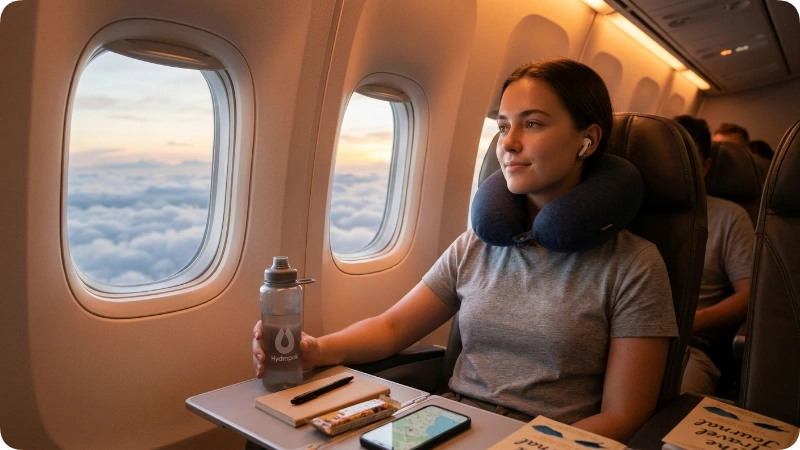
For flying, bring your ID, boarding pass, phone, charger, power bank, medicines, an empty water bottle, snacks, earbuds, and a light layer. Cabin air is dry and cold, so comfort items matter on long flights.
Here is a quick flying checklist:
- Before security: ID, boarding pass, liquids in a clear quart bag
- After security: Fill your water bottle
- On board: Neck pillow, eye mask, lip balm, moisturizer, compression socks for long flights
- Backup: Printed hotel address and one day of clothes in your carry-on
Arrive early. Many airports such as Atlanta, Chicago O’Hare, and Los Angeles can have long security lines at peak hours. Consider TSA PreCheck if you fly often, and confirm current details on the official site.
Travel Essentials for Ladies
Travel essentials for ladies include all the core items plus personal care products, a crossbody bag, comfortable shoes, a scarf, and extra hair and skin care basics. Many women also pack feminine hygiene products and a small pouch for emergencies.
Useful extras include:
- Hair ties, clips, and a travel brush
- Makeup in a small, leak-proof pouch
- A lightweight scarf or shawl for warmth or modest dress
- A crossbody bag with a zipper for safety
- A mini sewing kit or stain remover pen
- A portable safety alarm if you travel solo
Put liquids in leak-proof bottles and inside zip bags. Choose shoes you can walk in all day. Style matters, but comfort wins when you are on your feet for hours.
Travel Essentials for Men
Travel essentials for men include the core list plus grooming tools, a compact toiletry kit, versatile clothing, a belt, and comfortable walking shoes. Keep it simple and pack items that work together.
Useful extras include:
- Razor, shaving cream (travel size), and after-shave
- Deodorant and cologne in a small bottle
- One pair of dark pants that dress up or down
- A light jacket or packable rain shell
- A slim wallet and a belt without a heavy buckle for easy screening
- A watch or fitness tracker with a charger
A hanging toiletry bag is helpful in small hotel bathrooms. Check that razor blades follow TSA rules for carry-on versus checked bags.
Travel Essentials for Girls
Travel essentials for girls include comfortable clothes, a phone and charger, skin care basics, a small bag, snacks, and personal safety items. Teens and young women should also share their plans with a trusted person.
Helpful items include a crossbody purse, a reusable water bottle, a light sweater, sunscreen, and hair accessories. A journal or book keeps long trips fun.
Safety matters most. Save emergency contacts, share your live location with family, and keep your ID in an inside pocket. If a minor travels alone, check the airline’s unaccompanied-minor rules in advance.
Travel Essentials Pakistan
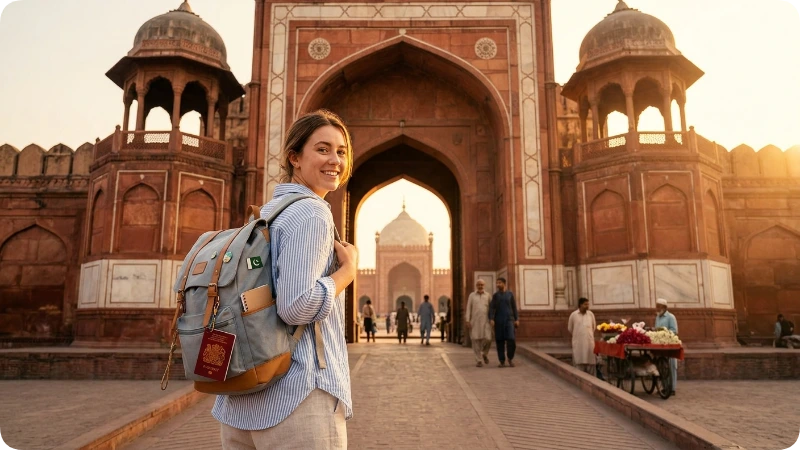
For Pakistan, pack your passport (with enough validity), visa or entry documents, medicines, a plug adapter, modest and breathable clothing, sunscreen, and a power bank. Many USA travelers visit family or explore cities like Lahore, Karachi, and Islamabad, plus northern areas like Hunza.
Here are helpful tips:
- Documents: Check passport and visa rules with Pakistan’s official sources. Carry printed copies.
- Health: Visit a travel clinic well before departure. Review CDC travel health notices for vaccines and food safety.
- Power: Pakistan uses 230V outlets, so bring a suitable adapter and check that your devices handle the voltage.
- Clothing: Light cotton for summer heat. Warm layers for northern mountains in cooler months.
- Safety: Check the U.S. State Department travel advisory and consider enrolling in STEP.
Rules and advisories change often, so confirm everything on official pages before booking.
Travel Essentials Products
The most useful travel essentials products are packing cubes, a power bank, a universal adapter, a refillable bottle, a toiletry bag, and a good carry-on bag. These items last for years and make every trip easier.
Here is a quick buying guide:
| Product | Why It Helps |
| Packing cubes | Keep clothes organized |
| Power bank | Charges phone on the go |
| Universal adapter | Works abroad |
| Toiletry bag | Stops leaks and spills |
| Luggage tag | Helps return lost bags |
| Travel pillow | Improves rest on flights |
Focus on quality for items you use often, like bags and shoes. Save money on small items. Read reviews and check return policies before you buy.
Travel Essentials Amazon
Amazon is a popular place to buy travel essentials because it offers many brands, fast shipping, and customer reviews. Look for packing cubes, adapters, power banks, and toiletry bottles, then compare options before you buy.
Shop smart with these tips:
- Read both good and bad reviews
- Check for TSA-friendly sizes on liquid containers
- Choose power banks that meet airline limits (usually listed in watt-hours; check your airline)
- Verify the return window
- Compare prices at other stores like Target, Walmart, or REI
Prices and stock change quickly, so check the current listing. Order at least a week before your trip so you have time to test new gear at home.
What Are the Top 10 Essential Travel Gadgets?

The top 10 essential travel gadgets are a power bank, universal adapter, noise-canceling earbuds, portable luggage scale, smart tracker, e-reader, multi-port charger, phone tripod, travel router, and a compact camera or action cam. They save time and stress.
Here is why they help:
- Power bank: Never run out of battery.
- Universal adapter: Charge anywhere.
- Noise-canceling earbuds: Calm flights.
- Luggage scale: Avoid overweight fees.
- Smart tracker: Find lost bags (put one in checked luggage).
- E-reader: Hundreds of books, one light device.
- Multi-port charger: One outlet, many devices.
- Phone tripod: Better photos without asking strangers.
- Travel router: Safer Wi-Fi in hotels.
- Compact camera: Great shots, small size.
What Are the Best Travel Accessories for 2026?
The best travel accessories for 2026 include compact power banks, smart luggage trackers, packable daypacks, anti-theft crossbody bags, and eco-friendly refillable bottles. Look for light, durable, and multi-use designs.
Trends this year point to smarter and greener gear. Many travelers like trackers that work with their phone’s finder app. Others choose bags made with recycled fabrics. Collapsible items, like silicone bottles and folding totes, are also popular.
Before you buy anything new, ask if you will use it at least three times a year. If not, borrow or skip it. Check airline rules too, since battery limits and bag sizes can vary.
What Are the 5 Biggest Packing Mistakes to Avoid?
The five biggest packing mistakes are overpacking, forgetting chargers, putting valuables in checked bags, ignoring the weather, and wearing new shoes untested. Each one is easy to fix with a little planning.
- Overpacking. Fix: Use the 5-4-3-2-1 rule and plan one laundry day.
- Forgetting chargers and adapters. Fix: Pack them first and keep them in one pouch.
- Checking valuables. Fix: Keep medicines, electronics, and documents in your carry-on.
- Skipping the forecast. Fix: Check the weather three days before and pack layers.
- Wearing new shoes. Fix: Break them in at home to prevent blisters.
A bonus tip: leave space. A bag packed to the limit leaves no room for gifts or souvenirs.
FAQs
What is the best way to pack a carry-on bag?
The best way to pack a carry-on is to put heavy items near the wheels, roll or cube your clothes, and keep liquids and electronics on top for easy screening. Wear bulky shoes and jackets on the plane. Leave a little space so the bag zips easily and fits the airline sizer.
How early should I start packing for a trip?
Start packing two to three days before you leave for domestic trips and about a week before for international trips. Begin with a list. Wash needed clothes early, charge devices, and print documents. Early packing lets you spot missing items and buy them calmly.
Do I need travel insurance?
Travel insurance is not required for most domestic trips, but it can protect you from costs like cancellations, medical emergencies, and lost bags. It matters most on expensive or international trips. Compare coverage, read exclusions, and check what your credit card or health plan already covers.
What should I never pack in checked luggage?
Never pack medicines, passports, cash, jewelry, laptops, or spare lithium batteries in checked luggage. Keep these in your carry-on. Airlines and the FAA limit lithium batteries in the cargo hold, and lost checked bags happen. Verify current rules on the TSA and airline websites.
How can I save money on travel essentials?
You can save money by making a list, buying only what you will reuse, and shopping sales or secondhand. Use travel-size bottles you already own. Borrow gear like carry-ons from friends. Test new items at home so you do not pay for last-minute airport replacements.
Conclusion
Packing well is a skill, and it gets easier with each trip. Here are three takeaways:
- Start with the core list: documents, money, medicines, phone, charger, and clothing basics.
- Use a simple rule: 3-3-3 for short trips, 5-4-3-2-1 for a week.
- Keep important items in your carry-on and check official rules before you fly.
A lighter, smarter bag means more time to enjoy the trip. Save the master list from this guide to your phone and tweak it for each adventure. Then zip up, step out, and let the road open ahead of you.

Ben Fogle believes that true adventure begins where the pavement ends. After spending years documenting extreme environments, rowing across oceans, and trekking through frozen landscapes, he mastered the art of wilderness travel. For Travelmarse, Ben constructs highly detailed guides on deep-nature packing lists, wildlife safety, and sustainable eco-tourism. He breaks down intimidating, rugged expeditions into clear, step-by-step roadmaps so everyday travelers can safely connect with the natural world.





1 thought on “Travel Essentials: The Complete Packing Guide for USA Travelers”