
Packing for Rome, Florence, or the Amalfi Coast should feel exciting, not confusing. Yet every year, thousands of American travelers stall out at the booking stage, worried they’ve missed some new European entry rule. Between ETIAS headlines, EES biometric checks, and outdated blog posts still quoting old fees, it’s genuinely hard to know what’s true right now.
This guide breaks down exactly what US citizens need for Italy in 2026: passport rules, the real ETIAS timeline, the 90/180-day rule, budget expectations, cultural etiquette, and the mistakes that trip up first-time visitors. Every fact here reflects the most current, verified information available, with a reminder to double-check official sources before you fly, since travel policy can shift quickly.
Quick answer:
No. US citizens do not need a visa for Italy for tourism, business, or family visits of up to 90 days within any 180 days. A valid US passport is enough to enter Italy and the rest of the Schengen Area. ETIAS, a low-cost travel authorization (not a visa), is expected to launch in late 2026 or 2027 but is not yet required.
Do US Citizens Need a Visa for Italy?
No, US citizens do not need a visa to visit Italy for short stays. As a Schengen Area member, Italy allows US passport holders to enter visa-free for up to 90 days within any 180 days, for tourism, visiting family, or business meetings.
This visa-free arrangement has existed for decades and remains unchanged in 2026. It applies to leisure trips, most business travel, and family visits. It does not apply to long-term study, work, or residency, which still require an application to an Italian consulate before travel.
Your passport must be valid for at least three months beyond your planned departure date from the Schengen Area, and it should have been issued within the last 10 years. Airlines routinely check this before boarding, so it’s worth confirming early.
What Are the Entry Requirements for Italy in 2026?
Entry requirements for US citizens visiting Italy in 2026 include a valid passport (with at least three months’ validity beyond departure), proof of onward travel, evidence of sufficient funds, and, for first-time Schengen entries, participation in the EU’s biometric Entry/Exit System (EES) at the border.
What to have ready when you travel:
- A US passport valid at least 3 months past your departure date
- Return or onward flight confirmation
- Proof of accommodation (hotel bookings or a host’s address)
- Evidence you can cover your stay financially (bank statements or a credit card are usually sufficient)
- Travel insurance, which isn’t legally required for Americans but is strongly recommended
Border officers rarely ask for all of this, but they can, especially if something about your trip raises questions. Keep digital and printed copies of your itinerary just in case.
Since April 10, 2026, the EU’s Entry/Exit System has been fully operational at Italian borders, meaning first-time entrants now have fingerprints and a facial photo recorded electronically instead of receiving a passport stamp. This adds a few extra minutes at the border on your first Schengen entry.
Do US Citizens Need ETIAS for Italy?

Not yet. ETIAS (European Travel Information and Authorisation System) is a planned pre-travel screening for visa-exempt travelers, including Americans, but it has not launched. It was targeted for the last quarter of 2026, though EU officials have since signaled the launch will likely slip into 2027.
Here’s what changed: for most of 2026, the official ETIAS website stated operations would begin in the “last quarter of 2026.” In July 2026, that specific date was quietly removed. The page now simply says ETIAS “is currently not in operation,” with a date to be announced several months ahead of launch.
What this means for your trip:
If you’re traveling to Italy any time soon, you do not need to apply for anything. There is no ETIAS application open, no fee to pay, and no form to fill out. Be cautious of third-party websites charging for ETIAS “pre-registration,” since these are not legitimate.
When Will ETIAS Start?
There is currently no confirmed launch date. EU officials had targeted Q4 2026, but internal reporting suggests a 2027 start is now more likely, pending a formal review at eu-LISA’s board meeting in September 2026.
How Much Will ETIAS Cost?
The confirmed fee is €20 per adult applicant (roughly $22 USD), covering a travel authorization valid for up to three years or until your passport expires, whichever comes first. Travelers under 18 or over 70 will be exempt from the fee but will still need to apply.
Who Will Need to Fill Out an ETIAS Form?
Once live, ETIAS will be required for passport holders from around 60 visa-exempt countries, including the US, Canada, Australia, and the UK, traveling to 30 European countries for stays under 90 days. Every traveler, including infants, will need an individual authorization.
Can I Apply for ETIAS Online Right Now?
No. Applications are not being accepted yet anywhere, including the eventual official portal at travel-europe.europa.eu. The only trustworthy source for ETIAS updates is the official EU travel authorization website; avoid paying any third-party company claiming to process applications early.
Bottom line:
even once ETIAS launches, it is not a visa. It’s closer to the ESTA system used for US-bound travelers, an inexpensive, mostly automated screening step, not a reason to delay booking a trip to Italy.
What Is the EU Entry/Exit System (EES) and How Does It Affect You?
EES is a separate, already-active border system that replaces manual passport stamps with biometric registration, fingerprints, and a facial photo for non-EU travelers, including Americans, on their first entry to the Schengen Area. It has been fully operational since April 10, 2026.
Unlike ETIAS, EES isn’t something you apply for in advance. It happens at the physical border, either with an officer or at a self-service kiosk. First-time registration takes a few minutes; later crossings are much faster since your biometric data is already on file.
Practical tip: budget extra time at passport control on your first trip after the EES rollout, especially during peak summer travel or holiday weekends, when queues have been longer than usual at major airports.
Can US Citizens Get an Italy Visa on Arrival?
There is no “visa on arrival” option for Italy because US citizens don’t need a visa for qualifying short stays in the first place. Entry is granted directly at passport control based on your US passport and the standard 90/180-day allowance.
If your trip involves something outside tourism or short business visits, like long-term study, employment, or family reunification lasting more than 90 days, you must apply for the appropriate visa at an Italian consulate in the US before departing. These cannot be arranged after you land.
How Much Money Should You Show at Italian Border Control?
There’s no fixed minimum bank balance published by Italian authorities, but border officers can ask for proof you can support yourself, generally interpreted as enough to cover accommodation, meals, and a return ticket. A reasonable benchmark cited by travel advisors is roughly $50-100 per day of your stay.
In practice, most US travelers are never asked to prove funds unless something else about their trip looks unusual, such as a one-way ticket with no clear onward plan. Still, carrying a credit card and recent bank statement (digital is fine) removes any doubt.
Is $10,000 Enough for a Trip to Italy?
For most travelers, yes, $10,000 comfortably covers an extended, even luxurious, Italy trip for one or two people, including flights, mid-range to upscale hotels, meals, and several regional excursions. A budget-conscious two-week trip for one person can realistically cost $2,500-$4,000, while $10,000 allows real flexibility for longer stays or multiple cities.
Rome, Florence, and Venice tend to run more expensive than southern regions like Puglia or Sicily. Building in a buffer of 15-20% above your planned budget is a smart habit, since museum tickets, transport, and dining add up quickly.
Which European Countries Can US Citizens Travel to Without a Visa?
US citizens can travel visa-free for short stays to all 29 Schengen Area countries, which share one combined 90/180-day allowance. This includes Italy, France, Spain, Germany, Greece, Portugal, and most of Western and Central Europe.
That combined allowance is important: your 90 days aren’t per country; they’re shared across the entire Schengen zone. If you spend two weeks in Italy and then continue to Greece or France, all of those days count against the same 90-day total.
Non-Schengen European countries, like the UK and Ireland, have their own separate entry rules and are not affected by ETIAS or the Schengen day count.
Is Italy Still Accepting US Citizens? Is It Safe to Visit Right Now?
Yes, Italy remains fully open to US travelers, and there is no broad entry restriction in place. The US Department of State currently rates Italy at its standard “Exercise Normal Precautions” advisory level, the lowest of its four-tier system, similar to most Western European destinations.
Standard precautions apply in busy tourist areas: pickpocketing near major train stations and crowded landmarks like the Trevi Fountain or Colosseum is the most common issue reported, not violent crime. Registering your trip with the US State Department’s STEP program is a free, worthwhile step before you fly.
Always verify current advisories directly on travel.state.gov before departure, since conditions and ratings can change.
What Not to Do in Italy as an American: Common Tourist Mistakes

Mistake 1: Expecting a cappuccino after 11 a.m.
Italians rarely order cappuccino post-morning; asking for one with dinner is a dead giveaway of a first-time visitor. Fix: order an espresso or macchiato after meals instead.
Mistake 2: Over-tipping aggressively.
Unlike the US, tipping in Italy is modest; rounding up or leaving a few euros is plenty; a 20% tip isn’t expected and can even seem confusing to servers. Fix: check if a “coperto” (cover charge) is already on the bill before adding extra.
Mistake 3: Wearing beachwear or gym clothes into churches.
Many major sites, including St. Peter’s Basilica, enforce dress codes that require shoulders and knees to be covered. Fix: pack a light scarf or shawl you can throw on before entering religious sites.
What Not to Wear in Italy as an American
Italians tend to dress a notch more polished than casual American streetwear; think tailored basics over athletic wear, flip-flops, or oversized graphic tees, especially in cities. You don’t need designer clothes, but neat, simple outfits help you blend in and are often required for church visits.
What Is the “Spaghetti Rule” in Italy?
The so-called spaghetti rule refers to Italian dining etiquette around eating long pasta like spaghetti properly, using only a fork to twirl it against the plate, never a spoon for cutting or a knife to slice it. It’s a small cultural detail, but locals notice, and it’s an easy way to show respect for the cuisine.
How to Not Stand Out as an American in Italy
Speaking a little Italian (even just “buongiorno” and “grazie”), dressing simply, avoiding loud conversation in public spaces, and skipping the fanny pack all go a long way. Blending in isn’t required, but a bit of cultural awareness makes interactions noticeably warmer.
What I Wish I Knew Before Going to Italy: Practical First-Timer Tips
Many repeat visitors say the biggest surprise is how much walking is involved; cobblestone streets are charming but hard on unsupported shoes, so comfortable, broken-in footwear matters more than style. Public restrooms can also be scarce and sometimes require a small fee.
A few more honest, practical notes:
- Many small shops and restaurants close for a few hours midafternoon (riposo), especially outside major cities.
- Not every card machine accepts contactless or foreign cards smoothly; carrying some cash avoids awkward moments.
- Free walking tours and museum reservations often need to be booked days, not hours, in advance during peak season.
- Water fountains (“nasoni”) in cities like Rome offer free, drinkable water, useful for refilling a bottle instead of buying one.
Best Time to Visit Italy
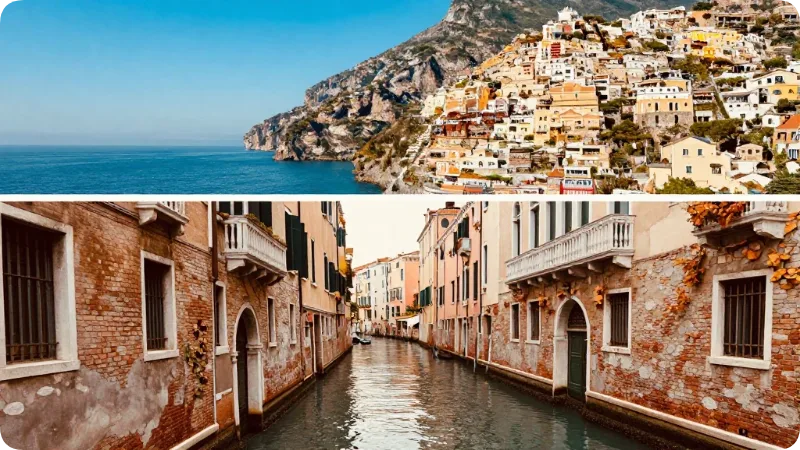
The best time to visit Italy is April-June or September-October, when temperatures are mild, crowds are thinner than peak summer, and prices sit below the July-August high season.
| Season | Months | Weather | Crowd Level | Good For |
| Shoulder (Spring) | April-June | Mild, occasional rain | Moderate | Sightseeing, hiking, fewer crowds |
| Peak Summer | July-August | Hot, dry, humid coastlines | Very high | Beaches, festivals, nightlife |
| Shoulder (Fall) | September-October | Warm days, cool evenings | Moderate | Wine harvest, food tourism |
| Off-Season | November-March | Cool, rainy in the north | Low | Budget travel, Christmas markets |
Summer delivers the classic postcard weather but also the highest prices, biggest crowds, and hottest temperatures, especially inland in cities like Florence. Winter offers real savings and near-empty landmarks, at the cost of shorter days and colder, wetter conditions in northern regions.
Which City in Italy Is the Cheapest to Visit?

Naples, Palermo, and Bari consistently rank among Italy’s most affordable major cities for US travelers, with lower hotel rates, cheaper meals, and less expensive public transport than Rome, Florence, Venice, or Milan.
Southern Italy and Sicily generally stretch a travel budget further across the board, food, lodging, and even museum entry, while still offering rich history, coastline, and food culture. Venice remains the most expensive city to visit day-to-day, driven largely by tourist-area dining and lodging costs.
Cash or Card in Italy: What’s Better for US Travelers?
Card is fine for most purchases in Italy today, but carrying some cash (€50-100) is still wise for small cafés, markets, public restrooms, and rural towns where card machines aren’t always reliable. Most hotels, restaurants, and larger shops accept major US credit cards without issue.
Notify your bank of travel dates in advance, and check for foreign transaction fees; some US cards charge 1-3% per purchase abroad, which adds up on a longer trip.
Can US Citizens Retire, Buy Property, or Move to Italy?

Yes, but not under the visa-free tourist rules. US citizens can retire in Italy through the country’s elective residency visa, which requires proof of stable passive income and typically leads to renewable residence permits. Buying property is legally open to Americans as well, though ownership alone does not grant residency rights.
These pathways require applying at an Italian consulate before relocating; they cannot be arranged casually during a 90-day tourist stay, and the process typically takes several months, with financial and housing documentation required upfront. Always confirm current requirements directly with the nearest Italian consulate, since income thresholds and paperwork can change.
What’s Not Allowed to Bring Into Italy?
Like the rest of the EU, Italy restricts bringing in most fresh meat, dairy, and plant products from outside the bloc, along with counterfeit goods, certain medications without a prescription, and cash amounts over €10,000 without declaration. Standard duty-free allowances apply for alcohol and tobacco.
If you’re carrying prescription medication, keep it in original packaging with your prescription or a doctor’s note, particularly for controlled substances, to avoid issues at customs.
FAQs
Do US citizens need a visa to go to Europe now?
No. US citizens can travel visa-free to all Schengen countries, including Italy, for stays up to 90 days within any 180 days. This applies to tourism, business meetings, and family visits, not long-term work or study.
Do Americans need ETIAS for Italy in 2026?
Not yet. ETIAS was targeted for late 2026 but is now more likely to launch in 2027, based on recent EU reporting. No application is currently open, and Americans can travel to Italy under existing visa-free rules in the meantime.
What is the official website of ETIAS?
The only legitimate source is the EU’s official travel authorization page at travel-europe.europa.eu. Third-party sites charging fees for “early registration” or “fast-track” ETIAS applications before launch are not affiliated with the EU.
Can US citizens travel to Italy right now?
Yes. There are no entry bans or special restrictions for US citizens visiting Italy in 2026. A valid passport and the standard 90-day allowance are all that’s required for tourism or business travel.
Do US citizens need a visa for Greece too, or just Italy?
No, the same rule applies. Greece is also a Schengen member, so US citizens can visit visa-free for up to 90 days, and that time counts against the same shared Schengen day limit as time spent in Italy.
What documents does a US citizen need to enter Italy?
A valid US passport (with at least 3 months’ validity remaining), proof of onward travel, and evidence of accommodation are the core essentials. Travel insurance isn’t mandatory but is highly recommended for medical emergencies abroad.
Is Italy friendly to US citizens right now?
Yes. Italy welcomes millions of American visitors annually, and there’s no indication of that changing. Normal safety precautions in crowded tourist areas are the main advisory in effect.
How long can a US citizen stay in Italy without a visa?
Up to 90 days within any rolling 180-day period, shared across the entire Schengen Area, not per country. Overstaying, even by a few days, can result in fines or future entry difficulties, especially once EES fully tracks entry and exit dates.
Is ETIAS the same as a visa?
No. ETIAS is a lightweight, mostly automated pre-travel screening, closer to the US ESTA system than a traditional visa. It doesn’t require an in-person interview, extensive paperwork, or weeks of processing time.
Do children need their own ETIAS once it launches?
Yes. Every traveler, regardless of age, will need an individual ETIAS authorization once the system goes live, though those under 18 (and over 70) will be exempt from the €20 fee.
What happens if ETIAS launches while I’m already planning a trip?
Nothing changes retroactively, and current guidance suggests a transitional grace period of at least six months after launch, during which travelers without ETIAS can likely still enter if they meet other entry conditions. It’s still wise to check the official EU site closer to your travel date.
Should I buy travel insurance for a trip to Italy even though it’s not required?
It’s strongly recommended, even though Italy doesn’t legally require it for US tourists. Emergency medical care abroad can be costly out-of-pocket, and insurance also typically covers trip cancellations, delays, and lost luggage.
Final Takeaways
US citizens can still travel to Italy visa-free in 2026, exactly as they have for decades, with a valid passport and the standard 90-day window. ETIAS is coming, but not yet, and it will function as a quick, affordable authorization rather than a traditional visa. The real story this year is EES, already live at the border and adding a short biometric step to your first Schengen entry.
The most useful thing any American traveler can do right now is simple: book with confidence, keep passport validity in mind, and check official sources (travel.state.gov and the EU’s ETIAS page) shortly before departure rather than relying on any single article, this one included, for last-minute policy changes.
Italy isn’t getting harder to visit. If anything, this is a good year to go before any new steps are added to the process. Buon viaggio.
Note: Visa, ETIAS, and entry policies can change. Always verify current requirements directly with the US Department of State (travel.state.gov) and the official EU ETIAS website before finalizing travel plans.

Ben Fogle believes that true adventure begins where the pavement ends. After spending years documenting extreme environments, rowing across oceans, and trekking through frozen landscapes, he mastered the art of wilderness travel. For Travelmarse, Ben constructs highly detailed guides on deep-nature packing lists, wildlife safety, and sustainable eco-tourism. He breaks down intimidating, rugged expeditions into clear, step-by-step roadmaps so everyday travelers can safely connect with the natural world.