
Every American assumes they can pack a bag and cross a state line without asking permission. That assumption is legally correct, and it has a name: the right to travel. But confusion around this phrase has spread online, mixing real constitutional protections with claims that courts have consistently thrown out.
This guide separates fact from myth. It walks through where the right to travel actually comes from, what the Supreme Court has ruled, why “right to travel without a license” arguments fail in court, and what documents and IDs travelers genuinely need in 2026, including the REAL ID rollout reshaping domestic flights right now.
If you searched this out of legal curiosity or because you’re prepping for a flight, you’ll leave with a clear, source-backed answer.
Featured Snippet:
The right to travel is a constitutionally recognized freedom. It allows U.S. citizens to move between states and return home without unreasonable government interference. It is rooted in the Privileges and Immunities Clause and the 14th Amendment. However, it does not exempt anyone from driver’s licensing, TSA identification rules, or state traffic laws. Courts have rejected such arguments for decades.
What Is the Right to Travel? 🧭
The right to travel is the legal principle that U.S. citizens can move freely between states, temporarily visit another state as a welcome guest, and settle permanently with equal treatment. It is not written out as a single sentence in the Constitution.
Instead, courts have built it from several sources: Article IV’s Privileges and Immunities Clause, the 14th Amendment, and the Commerce Clause. The Supreme Court has called it a “fundamental right,” meaning states cannot casually restrict it.
Importantly, this right protects interstate movement generally. It does not create a personal exemption from ordinary laws in, ing the requirement to hold a driver’s license to operate a motor vehicle.
The Right to Travel and the Bill of Rights
The Bill of Rights (the Constitution’s first ten amendments) never mentions “the right to travel” by name. Search interest in “right to travel bill of rights” usually stems from the belief that it should be listed alongside speech or religion; t isn’t, and that surprises people.
Instead, the right to travel is what legal scholars call an “unenumerated right.” Courts have recognized it through judicial interpretation rather than explicit constitutional text. The Ninth Amendment acknowledges that people may have rights beyond those specifically listed. Scholars often cite it as supporting groundwork for the right to travel. The 14th Amendment also plays an important role, as discussed next.
Key takeaway: Not being named in the Bill of Rights doesn’t make the right to travel weaker , t it does mean its exact boundaries come from case law, not a single constitutional sentence.
14th Amendment Right to Travel: Separating Law From Myth
The 14th Amendment’s Citizenship and Privileges or Immunities Clauses support much of modern right-to-travel doctrine. The doctrine includes the principle that new state residents must receive the same treatment as other citizens of that state. Courts have established this principle through longstanding case law.
What is not settled law, despite frequent claims, is that the 14th Amendment lets someone drive “without a license” because driving is supposedly a right rather than a regulated activity. Federal courts have rejected this argument consistently, with the Ninth Circuit holding in Miller v. Reed that while a fundamental right to travel exists, there is no fundamental right to drive a motor vehicle.
The Sixth Circuit similarly found that state licensing laws impose only an incidental and negligible burden on the right to travel, meaning states can require a license without violating anyone’s constitutional freedom to move.
Right to Travel Case Law: The Cases That Actually Matter

Three Supreme Court decisions form the backbone of right-to-travel law, and they’re worth knowing by name if you want to understand what courts protect and what they don’t.
Saenz v. Roe (1999) is the clearest statement of the doctrine. The Court identified three protected components. First, people have the right to enter and leave another state. Second, temporary visitors have the right to receive fair treatment as welcome visitors. Third, permanent residents have the right to receive the same treatment as other citizens of that state.
Shapiro v. Thompson (1969) struck down state laws that denied welfare benefits to new residents during a waiting period, reasoning that penalizing recent arrivals discourages interstate movement.
Attorney General of New York v. Soto-Lopez clarified the test courts use today: a state law implicates the right to travel when it actually deters travel, when impeding travel is its primary objective, or when it uses a classification that penalizes exercising the right. Ordinary driver’s licensing fails all three tests, which is why it consistently survives legal challenges.
“Right to Travel Unmolested” and Sovereign Citizen Claims: What Courts Say
Phrases like “right to travel unmolested” and “right to travel without a license” are hallmarks of the sovereign citizen movement, a loosely organized ideology claiming individuals can opt out of licensing, registration, and insurance laws by calling themselves “travelers” rather than “drivers.”
Courts have heard this argument thousands of times, and the outcome is uniform. Sovereign citizens differentiate between a driver and a traveler, an automobile and a motor vehicle, and commercial versus non-commercial use, then argue this distinction bars all government interference with travel absent probable cause. Federal courts routinely reject these claims as frivolous, citing decisions across multiple circuits that describe the theory as legally baseless.
State courts agree. One Ohio appellate court rejected a defendant’s claim to be an “unfranchised common law free man.” The defendant argued that this status allowed him to drive without a license. The court noted that Ohio law requires a valid license to operate a motor vehicle on public roads. It found no applicable exemption.
A Minnesota appellate court reached a similar conclusion. It held that permission to drive is a license or privilege, not a civil right. The court also explained that regulating one form of transportation does not eliminate the broader right to travel.
Bottom line: Courts have rejected “right to travel” arguments as a basis for driving without a license. Traffic violations can result in fines, license suspensions, or jail time, depending on the offense and state law. If you’re pulled over, comply first and challenge the law through proper legal channels afterward, n, on the roadside.
Myth vs. Reality: Right to Travel Claims
| Claim Often Made Online | What Courts Actually Rule |
| “I don’t need a license because I’m traveling, not driving” | Rejected in every jurisdiction; driving requires a valid license regardless of terminology |
| “The right to travel bars police from stopping me” | False; routine traffic stops and checkpoints are constitutional |
| “License plates and registration violate my rights” | States may lawfully require registration under police powers |
| “The 14th Amendment exempts me from state driving laws” | The 14th Amendment protects interstate movement, not licensing exemptions |
| “I can declare myself a sovereign citizen to avoid traffic law” | Courts treat this as a frivolous legal theory with no standing |
Is Freedom of Movement a Human Right?
Yes , nternationally, freedom of movement is recognized as a basic human right. Article 13 of the Universal Declaration of Human Rights states that everyone has the right to move freely within their own country and to leave and return to it.
Within the U.S. legal system, this international principle overlaps with ut isn’t identical to the domestic right to travel. The U.S. version is narrower and enforced through the Constitution and federal courts rather than international treaty bodies.
Practically speaking, this means Americans generally cannot be barred from leaving or re-entering the country without due process, though passport issuance and certain restricted categories (like active felony warrants or specific court orders) can limit that freedom in narrow circumstances.
What Are Free Movement Rights?
Free movement rights refer to the broader legal category covering both interstate travel (within the U.S.) and international travel (crossing borders). They include the right to relocate, to travel for work or leisure, and to return home without arbitrary restriction.
In the U.S. context, free movement rights break down into two practical layers:
- Domestic layer: Protected mainly by the Privileges and Immunities Clause and the 14th Amendment, enforced against state governments.
- International layer: Governed by federal passport law, State Department policy, and international agreements like visa waiver programs.
Neither layer eliminates ordinary regulation; irport security screening, passport requirements, and state driving laws all coexist with free movement rights because none of them are designed to prevent travel; they regulate how it happens.
Right to Travel Documents: What You Actually Need
“Right to travel documents” is a search term often tied to sovereign citizen templates claiming a homemade card can replace a driver’s license or passport. These documents have no legal standing and will not get you past TSA or across a border.
Legitimate travel documents in the U.S. include:
- State-issued driver’s license or ID (REAL ID-compliant, for domestic flights)
- U.S. passport book or passport card
- Global Entry or Trusted Traveler cards (accepted at TSA checkpoints)
- Permanent Resident Card for non-citizens
Children under 18 do not need ID for domestic flights, but every adult traveler needs one of the documents above.
TSA REAL ID Rules for 2026: What Every Traveler Needs to Know
📋 Quick Facts Table
| Detail | Current Status (2026) |
| Full enforcement began | May 7, 2025 |
| Who it affects | All air travelers age 18+ |
| Accepted alternative | U.S. passport, Global Entry card, Permanent Resident Card |
| Non-compliant traveler fee (ConfirmID) | $45, starting February 1, 2026 |
| Full phased enforcement completion | May 5, 2027 |
| Kids under 18 | No ID required |
REAL ID enforcement has been active at every U.S. airport since May 7, 2025, meaning travelers without a compliant driver’s license, passport, or other federally accepted ID face extra screening and a real risk of missing their flight. Beginning February 1, 2026, travelers who show up without an acceptable ID are referred to TSA’s ConfirmID process for identity verification before entering the security line, an optional but increasingly necessary backup.
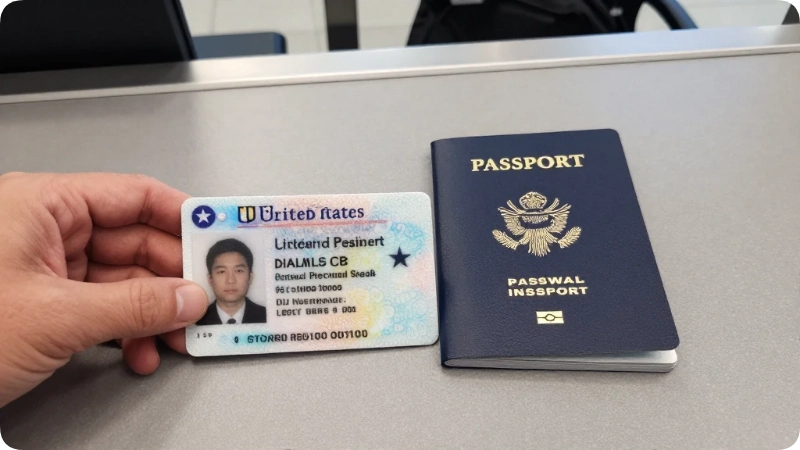
A REAL ID-compliant license typically displays a star cutout or marking in the upper corner of the card. If your license lacks this and says “federal limits apply,” it will not satisfy TSA on its own ; ng a passport as backup until you renew.
Verify before you fly: REAL ID rules have shifted multiple times over two decades. Always confirm current requirements directly at tsa.gov before a trip.
Are U.S. Citizens Allowed to Travel? Domestic and International Basics
Yes. U.S. citizens are free to travel domestically between all 50 states without a permit, and internationally with a valid passport, subject to destination-specific entry rules. There is no general federal restriction on where an American citizen may travel inside the country.
International travel requires more planning: a passport valid for your destination’s required period, any visas that country demands, and awareness of State Department travel advisories for the region. None of this restricts the right to travel; it regulates the conditions under which cross-border travel happens.
New Travel Requirements for 2026: ESTA, Visas, and Border Screening
Several practical changes are affecting travelers heading to and from the U.S. this year, mostly aimed at visitors rather than citizens.
U.S. Customs and Border Protection has proposed requiring Visa Waiver Program travelers applying through ESTA to disclose significantly more personal information, potentially including five years of social media presence and additional contact and family data. As of early 2026, the U.S. Embassy in France has confirmed these proposed changes are not yet in effectt,t and current ESTA procedures remain unchanged, with implementation possible starting mid-2026 at the earliest.
The ESTA application fee has also risen for UK visitors as part of broader 2026 border-control updates. Foreign visitors should apply well ahead of their trip and double-check requirements on the official CBP and State Department sites, since these rules are actively evolving.
Flag for readers: Visa, ESTA, and entry-fee details change quickly. Treat every figure above as a snapshot and confirm current requirements officially before booking.
Can International Visitors Still Travel to the USA?

Yes, in nearly all cases. The United States remains open to travelers from allied nations like the UK and Canada, though 2026 has brought stricter border checks and more scrutiny at ports of entry. Visitors from Visa Waiver Program countries, including Australia, continue to be eligible to enter with a valid ESTA for tourism or business stays up to 90 days, pending the standard approval process.
Government travel advisories from partner countries have added new guidance about what to expect at U.S. borders, including the possibility of device searches at ports of entry. This isn’t unique to any one nationality; it reflects tightened general screening rather than a ban on travel from any specific allied country.
Practical tip: Apply for ESTA or a visa at least a few weeks before departure, keep digital and printed copies of approval documents, and check your home country’s official travel advisory page for the latest U.S.-specific guidance.
New Flight Rules and the 45-Minute Rule, Explained.
Air travel rules are adjusted often, and two specific questions come up constantly.
What is the 45-minute rule? For most domestic flights, checked baggage must be accepted at least 45 minutes before scheduled departure, though some airports requiremoreo. Always confirm with your airline, since cutoffs vary by carrier and airport.
What are the new flight rules for 2026? Beyond REAL ID enforcement, airlines continue adjusting carry-on sizing, fee structures, and check-in windows individually. There’s no single sweeping federal rule change for passengers this year beyond identification requirements; the biggest disruption for everyday travelers remains REAL ID compliance at security checkpoints.
Common Mistakes People Make About the Right to Travel
Mistake 1: Assuming “right to travel” means no license is needed. Fix: Understand that driving is a regulated privilege, not a travel-blocking restriction; you can still walk, bike, fly, or take transit without a license.
Mistake 2: Waiting until the airport to check REAL ID compliance. Fix: Check your license for the star marking weeks before a flight, and carry your passport as a backup if you’re unsure.
Mistake 3: Assuming international right-to-travel rules apply the same way domestically. Fix: Treat the U.S. constitutional right to travel and the international freedom-of-movement principle as related but legally distinct frameworks.
Underrated and Overrated Aspects of the Right to Travel
Underrated: The Saenz v. Roe protection against being treated as a “second-class” new resident is one of the most practically useful nd least discussed parts of right-to-travel law, especially for people relocating for work.
Overrated: The idea that “right to travel” case law offers a shortcut around licensing or registration requirements. It has never worked in court and isn’t likely to start now.
Worth knowing either way: Getting REAL ID-compliant now avoids stress later, since enforcement is only getting stricter through 2027.
Why Travel Matters: The Bigger Picture
Beyond the legal definitions, travel serves a real purpose in people’s lives. It builds perspective, strengthens relationships, supports local economies, and for many Americans represents the practical exercise of the very right this article explores.
Interstate travel keeps families connected across state lines, supports over a million tourism-related jobs nationwide, and drives economic activity in border and gateway states. International travel builds cultural understanding that’s difficult to gain any other way.
Whatever inspires a trip a national park visit, a family reunion, or a bucket-list flight abroad that motivation is exactly what right-to-travel protections were built to preserve: the freedom to go.
The Future of Travel in America

Expect identity verification to keep tightening rather than loosening. REAL ID’s phased enforcement continues through 2027, biometric options like TSA ConfirmID are expanding, and ESTA reform for international visitors remains under active review.
None of this changes the underlying constitutional right to travel; t changes the paperwork required to exercise it smoothly. Travelers who stay ahead of ID and documentation requirements will feel the least friction as these systems roll out.
FAQs
Is freedom of movement a human right?
Yes. Article 13 of the Universal Declaration of Human Rights recognizes the right to move freely within one’s country and to leave and return to it. In the U.S., this international principle is echoed domestically through constitutional right-to-travel case law, though the two frameworks are legally distinct.
Does the 14th Amendment let me drive without a license?
No. Federal courts have consistently held that while a fundamental right to travel exists, there is no fundamental right to drive a motor vehicle. States can lawfully require a license, registration, and insurance without violating the right to travel.
What ID do I need to fly domestically in 2026?
You need a REAL ID-compliant driver’s license, a U.S. passport, a Global Entry card, or another federally accepted ID. This has been required at every airport since May 7, 2025, and non-compliant travelers face extra screening or fees.
What is the 45-minute rule for flights?
It’s the standard cutoff requiring checked baggage to be accepted at least 45 minutes before a domestic flight’s scheduled departure. Some airports set longer windows, so check with your airline before arriving.
Are U.S. citizens still allowed to travel internationally?
Yes. U.S. citizens can travel abroad with a valid passport, though destinations may require visas or have entry restrictions. Check the State Department’s travel advisories for your destination before booking.
What are the new travel requirements for 2026?
The biggest changes involve REAL ID enforcement for domestic flights and proposed (not yet active) ESTA reforms requiring more personal information from Visa Waiver Program visitors. As of early 2026, those ESTA changes remain under review and are not yet in effect.
Is the “right to travel unmolested” a real legal defense?
No. Courts across the country routinely reject this and similar sovereign citizen arguments as frivolous, and acting on them during a traffic stop can lead to fines or arrest rather than dismissal of charges.
What’s the difference between a right and a privilege in travel law?
A right (like interstate movement) can’t be casually restricted by the government. A privilege (like driving) is a regulated activity the state may condition on meeting requirements such as licensing, insurance, and age minimums.
Can my driver’s license be revoked without violating my right to travel?
Yes. Courts have held that a driver’s license is a privilege, not a civil right, so its revocation for cause doesn’t violate the constitutional right to travel; u can still travel by other means.
Do U.S. citizens need a visa to travel between states?
No. There is no visa, permit, or federal permission required to travel between U.S. states. Only certain licensed activities within a state, like driving, require documentation.
Are there official travel warnings for specific U.S. cities like New York?
The federal government does not issue safety ratings for individual U.S. cities to domestic or foreign tourists the way it does for other countries. General safety precautions apply anywhere, but there’s no official “avoid this city” advisory system for domestic travel.
Can Australians still travel to the USA under current rules?
Yes. Australia remains part of the Visa Waiver Program, so eligible Australian citizens can apply for ESTA and travel to the U.S. for tourism or business for up to 90 days, subject to standard approval and any current border screening measures.
Final Takeaways
The right to travel is real, constitutionally grounded, and protects genuinely important freedoms : ng between states, being treated fairly as a new resident, and leaving and returning to the country. What it does not do is exempt anyone from licensing, registration, or TSA identification requirements, no matter how that argument is phrased online.
Heading into a trip in 2026, the practical priority isn’t a legal theory it; making sure your ID is REAL ID-compliant and your passport is current well before departure. Confirm today’s requirements directly with TSA, CBP, or your destination’s official travel authority, since these details continue to shift.
Travel is one of the most valuable freedoms Americans hold. Understanding it accurately, egally a,,nd practically is what makes it possible to use that freedom without a hitch.

Maya Lin inspires travelers to explore the globe with absolute confidence and independence. Armed with a background in digital media and a decade of independent solo travel experience, she knows exactly how to navigate unfamiliar cities smoothly and safely. For Travelmarse, Maya curates the solo travel and hidden-gem verticals. She reviews charming boutique hotels, designs smart neighborhood walking routes, and shares practical language-learning hacks, giving readers the exact tools they need to travel solo without the stress.