How to Plan the Perfect Spain Trip is one of the most common questions first-time visitors ask before traveling to Spain.
A successful trip requires balancing iconic cities, regional experiences, transportation, timing, and budget.
Most US travelers should begin with Madrid, Barcelona, and Seville as anchor destinations, connected by Spain’s efficient high-speed AVE train network.
Ten days covers the essential circuit comfortably. Two weeks allows deeper exploration of Andalusia and the Mediterranean coast.
Three weeks opens up the Basque Country, Granada, and the Spanish islands without rushing.
Spain does something to first-time visitors that few countries manage. You arrive expecting beautiful architecture and good food, and you leave having experienced something that feels fundamentally different from ordinary tourism a culture that genuinely prioritizes living well, eating late, talking long, and moving through the day at a pace that most Americans find both disorienting and deeply appealing.
The challenge is that Spain is large, regionally diverse, and easy to plan badly. The most common mistake US travelers make is treating it like a single destination rather than a collection of distinct regions, each with its own food culture, architecture, traditions, and personality.
Learning how to plan the perfect Spain trip means understanding what to prioritize and what to leave for a future visit. An itinerary that tries to cover everything in ten days creates a rushed blur. One built around realistic geography and personal interests creates memories that last for years.
This guide covers complete 10-day, 14-day, and 21-day itineraries, along with practical advice on transportation, accommodations, budgeting, food, visa requirements for US citizens, and expert tips to help you experience Spain at its best.
Quick Facts: Spain Travel for US Visitors
| Detail | Information |
| Flight time from USA | ~8–10 hours from East Coast; ~12–13 hours from West Coast |
| Currency | Euro (€) verify current exchange rates |
| Visa required | No US citizens get 90 days in the Schengen Area visa-free |
| Best months | April–June and September–October |
| High-speed train (AVE) | Madrid–Barcelona: ~2.5 hrs; Madrid–Seville: ~2.5 hrs |
| Language | Spanish (Castilian); Catalan in Barcelona; Basque in the north |
| Driving side | Right |
| Tipping culture | Not mandatory; 5–10% appreciated at restaurants |
| Time zone | CET (Central European Time) 6 hours ahead of Eastern |
Always verify visa requirements, entry rules, and travel advisories at travel.state.gov before departure.
Best Time to Visit Spain: Seasonal Breakdown
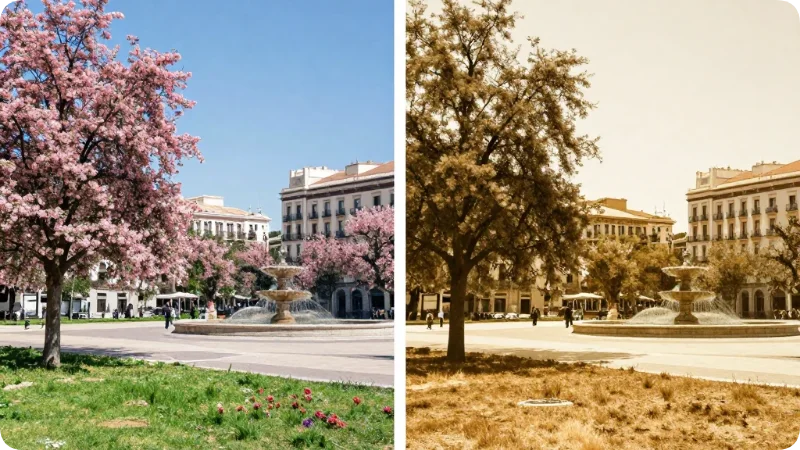
Spring (April through June) and fall (September through October) are the best seasons for a Spain travel itinerary. Both periods deliver comfortable temperatures, manageable crowds at major sites, and the most authentic version of daily Spanish life before and after the summer tourist peak.
Summer (July and August) brings extreme heat to inland cities. Madrid and Seville regularly exceed 100°F in July, making midday outdoor sightseeing genuinely uncomfortable. Barcelona’s coast remains popular, but crowds at Sagrada Família, Park Güell, and the Gothic Quarter hit their absolute maximum.
Hotel prices peak and availability tightens across the country. If summer is your only option, prioritize northern Spain the Basque Country, Galicia, and the Cantabrian coast where temperatures stay in the 70s°F and crowds are far more manageable.
Winter (November through February) brings cold temperatures to Madrid and central Spain (nighttime lows regularly drop below freezing), mild and rainy conditions in Seville and Andalusia, and the most affordable prices of the year.
Key attractions remain open; Madrid and Barcelona maintain active cultural calendars. The Canary Islands off Africa’s northwest coast deliver reliable warmth year-round and deserve consideration for winter Spain trips.
| Season | Temperatures | Crowds | Prices | Best For |
| Spring (Apr–Jun) | 60–80°F | Moderate | Mid | City sightseeing, culture |
| Summer (Jul–Aug) | 85–105°F | Very high | High | Coast, northern Spain |
| Fall (Sep–Oct) | 65–85°F | Moderate | Mid | All-around best value |
| Winter (Nov–Mar) | 45–65°F | Low | Low | Budget travel, museums |
Getting to Spain from the USA: Flights and Entry Requirements
US citizens do not need a visa to visit Spain for trips up to 90 days within any 180-day period under the Schengen Agreement. Your US passport must be valid for at least three months beyond your planned departure date from the Schengen Area. Always verify current entry requirements at travel.state.gov before booking, as policies change.
Several US airlines and European carriers fly direct from major American hubs to Spain’s primary airports. Madrid’s Adolfo Suárez Madrid–Barajas Airport (MAD) and Barcelona–El Prat Airport (BCN) receive the most direct US service.
Iberia, the Spanish national carrier, operates direct routes from New York JFK, Miami, Chicago O’Hare, Los Angeles, and Boston. American Airlines, Delta, and United all serve Madrid and Barcelona with varying frequency. Seville’s San Pablo Airport (SVQ) connects to US travelers primarily through Madrid or other European hubs.
Insider tip: Flying into Madrid and out of Barcelona (or vice versa) eliminates backtracking and suits most 10–14 day Spain itineraries naturally. Search open-jaw flights different arrival and departure cities on booking platforms, as they’re often priced competitively compared to round-trip from a single city.
The EU’s ETIAS (European Travel Information and Authorization System) electronic travel authorization system for US citizens was in development as of mid-2025. Verify If ETIAS has launched and If it applies to your travel at the official ETIAS website and travel.state.gov before departure, as requirements may have changed.
Getting Around Spain: Trains, Flights, and Regional Transport
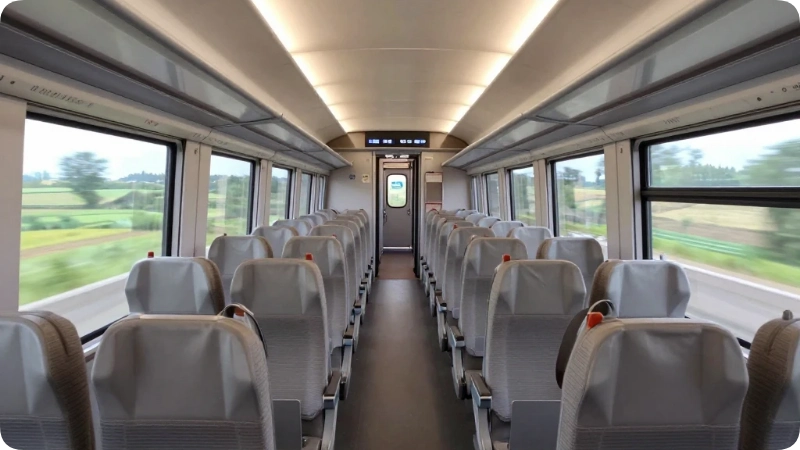
Spain’s transport infrastructure is genuinely excellent, and understanding it changes how you plan your itinerary. The AVE high-speed rail network connects Spain’s major cities at speeds up to 200 mph, making train travel faster than flying when you factor in airport time on many routes.
AVE high-speed train routes worth knowing:
- Madrid to Barcelona: approximately 2 hours 30 minutes
- Madrid to Seville: approximately 2 hours 30 minutes
- Madrid to Valencia: approximately 1 hour 45 minutes
- Barcelona to Valencia: approximately 3 hours
- Seville to Granada: no direct AVE; regional trains or bus (approximately 3 hours)
RENFE (Red Nacional de los Ferrocarriles Españoles) operates the Spanish national rail network, including AVE services. Book through renfe.com or through Trainline for international travelers. Book in advance particularly for travel in spring and fall as popular routes sell out and advance pricing is significantly lower than walk-up fares.
Budget airlines Vueling, Iberia Express, Ryanair, and EasyJet connect Spanish cities and nearby destinations at low fares, but when you add baggage fees and airport transfer time, the price advantage over trains often disappears on main-city routes. Air travel makes more sense for reaching the Balearic or Canary Islands, or for longer cross-country distances.
Renting a car makes sense for rural Andalusia, exploring the Camino de Santiago corridor, visiting small villages in Castile, or reaching the more remote areas of northern Spain. Driving between major cities is unnecessary and usually slower than the AVE. An International Driving Permit (IDP) is recommended alongside your US license verify current requirements with the AAA or your destination country’s transport authority.
10-Day Spain Travel Itinerary: The Essential Circuit
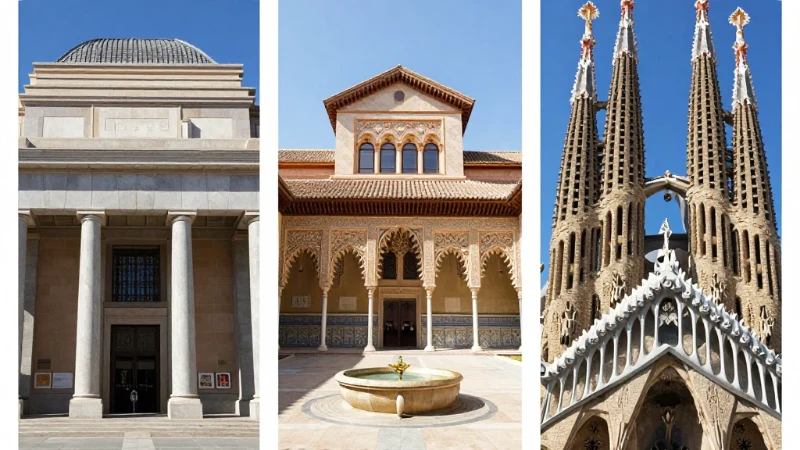
Ten days is the minimum that allows you to experience Madrid, Toledo, Seville, and Barcelona without feeling like you’re sprinting. This itinerary uses the AVE to connect cities efficiently and prioritizes depth over coverage.
Day 1–3: Madrid
Arrive at Adolfo Suárez Madrid–Barajas Airport and transfer to central Madrid. The airport Metro (Line 8) connects to Nuevos Ministerios in about 15 minutes and provides the most affordable transfer option verify current fares and Metro maps at metromadrid.es.
Madrid rewards exploration on foot. The Prado Museum one of the greatest art collections in the world, housing Velázquez’s Las Meninas, Goya’s Black Paintings, and works by El Greco and Hieronymus Bosch deserves a full half-day minimum. Book tickets in advance at museodelprado.es, especially between April and October, to skip queuing at the door.
The Reina Sofía museum houses Picasso’s Guernica alongside important works from the Spanish surrealists and Civil War period. The Thyssen-Bornemisza rounds out Madrid’s “Golden Triangle of Art” three world-class museums within walking distance of each other along the Paseo del Prado.
Beyond the museums: the neighborhood of La Latina for tapas, the El Rastro flea market on Sunday mornings, the historic Plaza Mayor, and the Retiro Park 350 acres of green space with a lake, a crystal palace, and locals of every age enjoying what Madrid residents do better than almost anyone: being outside in their city.
Day 4: Toledo (Day Trip from Madrid)
Toledo sits 70 kilometers south of Madrid and served as Spain’s capital before Madrid it carries a thousand years of layered history in a compact medieval hilltop city. The cathedral, El Greco’s house and museum, the Jewish Quarter, and the Alcázar fortress all concentrate within walking distance of each other.
The RENFE Avant train from Madrid Atocha to Toledo runs in approximately 30 minutes. Day-trip logistics are straightforward: morning train, full day exploring, evening return. Alternatively, spend a night in Toledo to experience the city after the day-trippers leave its atmosphere after dark is genuinely different.
Day 5–7: Seville
Take the AVE from Madrid Atocha to Seville Santa Justa (approximately 2.5 hours). Seville is the capital of Andalusia and the heartland of flamenco, bullfighting tradition, tapas culture, and one of the most extraordinary Gothic cathedrals in the world.
The Seville Cathedral the largest Gothic cathedral on earth contains the tomb of Christopher Columbus and the Giralda tower, a 12th-century Moorish minaret converted into a bell tower. Climbing the Giralda (via a series of ramps, not stairs) delivers panoramic views across Seville’s terracotta roofscape. Book entry at catedraldesevilla.es and arrive early.
The Real Alcázar palace complex next to the cathedral is a UNESCO World Heritage Site and one of Spain’s most visually striking buildings Moorish architecture built by Christian kings, layered with intricate tilework, garden courtyards, and royal apartments. It appeared as the Water Gardens of Dorne in Game of Thrones. Book tickets well in advance at alcazarsevilla.es this site sells out frequently.
The Barrio Santa Cruz, Seville’s former Jewish quarter, is a maze of narrow whitewashed lanes, orange trees, and hidden plazas that rewards aimless wandering. Evenings in Seville run late dinner at 9 or 10 PM is completely normal and the tapas tradition here differs from Madrid: at many traditional bars in Seville, a free tapa comes with every drink you order.
Day 8–10: Barcelona
Fly or take the AVE from Seville to Barcelona (there’s no direct AVE; connect through Madrid, or fly verify current options). Barcelona operates on a different cultural frequency from the rest of Spain Catalan identity, language, and food culture distinguish it sharply from Castilian Spain.
Antoni Gaudí’s Sagrada Família is the most visited monument in Spain and one of the most extraordinary pieces of architecture in the world a cathedral begun in 1882 that remains under construction. Book tickets well in advance at sagradafamilia.org, include a tower access ticket, and arrive at your reserved time slot. Gaudí’s other works Casa Batlló, Casa Milà (La Pedrera), Park Güell, and Palau Güell are spread across the city and collectively form one of the richest architectural itineraries of any city in Europe.
The Gothic Quarter (Barri Gòtic) contains Roman ruins beneath medieval streets the Temple of Augustus, hidden inside a courtyard off Carrer del Paradís, preserves four intact Roman columns from the 1st century BC. La Barceloneta beach sits ten minutes from the Gothic Quarter on foot, and the beachfront promenade connects to the Port Olímpic.
El Born neighborhood offers Barcelona’s best mix of authentic local atmosphere, independent shops, and excellent restaurants. The Mercat de Santa Caterina less crowded than La Boqueria and genuinely used by locals provides a better market experience than its famous neighbor.
14-Day Spain Travel Itinerary: Adding Granada and the Costa del Sol
Two weeks allows you to add Granada arguably the single most spectacular destination in all of Spain plus either the Costa del Sol coast or an extension into the Basque Country.
Follow the 10-day itinerary through Seville, then add:
Day 8–10: Granada
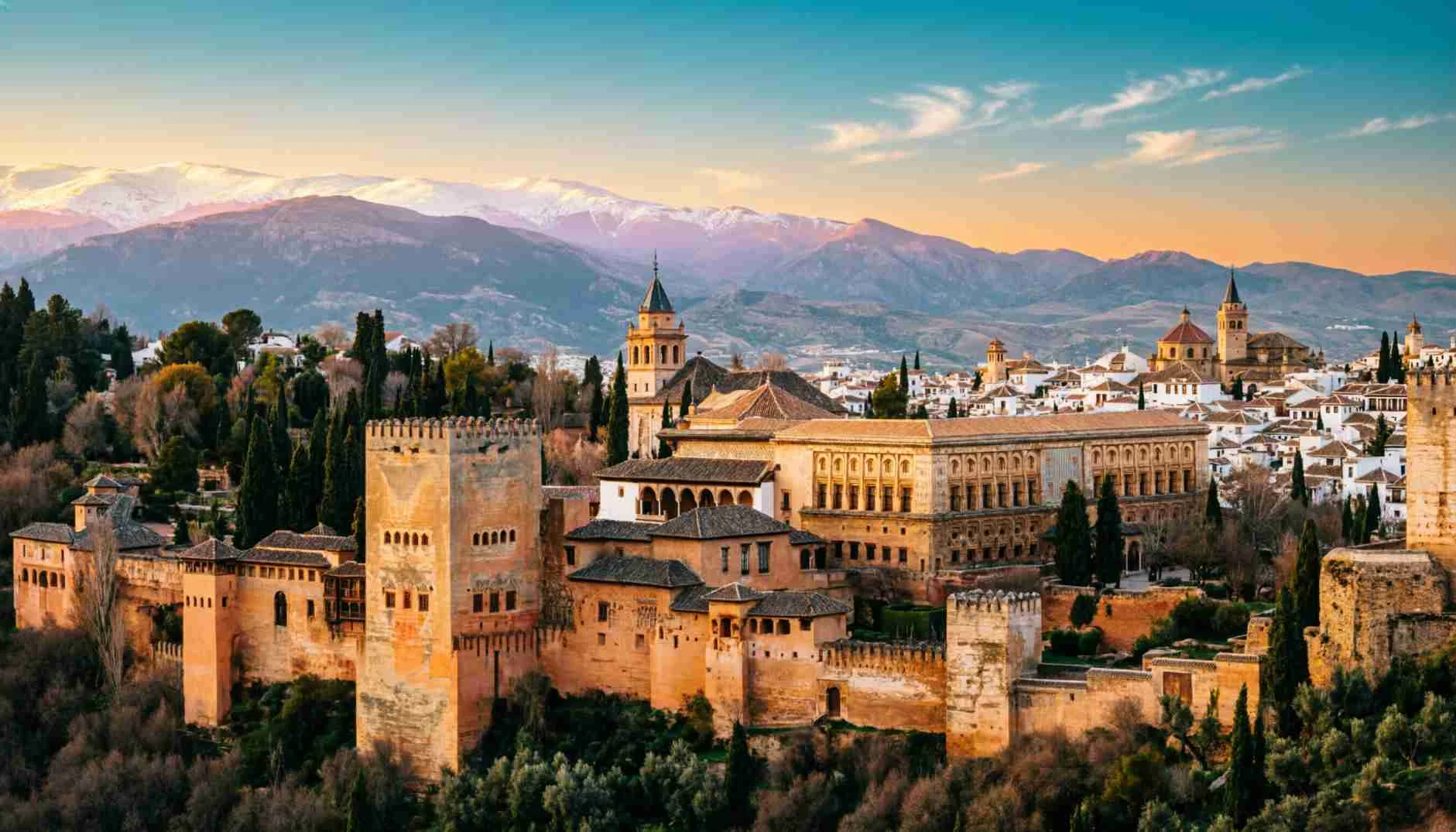
Granada sits about three hours from Seville by bus or regional train. The Alhambra palace complex a Nasrid dynasty fortress and palace from the 13th and 14th centuries, with Islamic geometric architecture, reflecting pools, and gardens of extraordinary refinement is the most visited monument in Spain and one of the most significant architectural achievements in European history.
Book Alhambra tickets the moment your dates are confirmed. The Nasrid Palaces section (the most spectacular interior) sells a fixed number of tickets per entry time slot, and they regularly sell out weeks or months in advance. Book at alhambra-patronato.es or directly through the official Alhambra website. Attempting to purchase tickets on arrival or at the gate almost always results in disappointment.
Beyond the Alhambra: the Albaicín neighborhood the old Moorish quarter across the valley from the palace climbs a hillside of whitewashed houses, carmens (private walled garden homes), and viewpoints (miradores) that look directly across at the Alhambra. The Mirador de San Nicolás delivers the classic Alhambra view and is particularly breathtaking at sunset and under floodlights after dark.
Day 11–12: Return to Seville, then Barcelona
Day 13–14: Barcelona extensions use remaining days to explore Montjuïc, the Picasso Museum in El Born, a day trip to Montserrat (the striking mountain monastery an hour from Barcelona by train and rack railway), or the Salvador Dalí Theatre-Museum in Figueres (approximately 2 hours from Barcelona by train).
21-Day Spain Travel Itinerary: The Full Experience
Three weeks in Spain allows genuine immersion rather than just sightseeing. After completing the 14-day circuit, add:
Days 15–17: Basque Country (San Sebastián and Bilbao)
San Sebastián (Donostia in Basque) on the Bay of Biscay is widely regarded as having the highest concentration of Michelin-starred restaurants per capita of any city in the world. The pintxos culture small bar snacks typically placed on bread and priced individually means you can eat extraordinarily well by moving from bar to bar in the Parte Vieja (Old Town) for a relatively modest cost. The beaches La Concha in the city center, Zurriola across the river are beautiful and functional.
Bilbao, 90 minutes from San Sebastián, anchors its identity on the Guggenheim Museum Bilbao Frank Gehry’s titanium-clad landmark that transformed the city’s global profile when it opened in 1997. Beyond the museum, Bilbao’s Casco Viejo (Old Quarter) has its own pintxos bar scene and a less touristic character than San Sebastián.
Days 18–19: Camino de Santiago (Partial Walk)
The Camino de Santiago is a network of pilgrimage routes converging on the Cathedral of Santiago de Compostela in Galicia, northwestern Spain. The most popular route the Camino Francés enters Spain at the Pyrenees and covers approximately 500 miles over 30 days. For travelers without a month to spare, walking the final 100 kilometers from Sarria to Santiago de Compostela qualifies for the Compostela certificate and takes four to five days.
For a 21-day itinerary, two days of walking from O Cebreiro into Galicia provides a meaningful taste of the Camino experience pilgrimage refuges (albergues), waymarked trails through green Galician countryside, and the communal culture of the Camino without committing a full month.
Days 20–21: Santiago de Compostela
The Cathedral of Santiago de Compostela, at the end of all Camino routes, is a magnificent Romanesque structure with an elaborate Baroque façade. The Pilgrim Mass at noon draws pilgrims, tourists, and believers together in a ceremony that has repeated daily for centuries. The old town surrounding the cathedral is a UNESCO World Heritage Site and one of Spain’s most atmospheric pedestrian zones.
Where to Stay in Spain: Accommodation Guide
Spain offers accommodation across every budget level, with several categories worth understanding specifically.
Paradores are a network of state-run luxury hotels housed in historic buildings castles, monasteries, convents, and palaces across Spain. The Parador de Granada sits within the grounds of the Alhambra complex itself, making it one of the most extraordinary hotel locations in Europe. Paradores range from mid-range to expensive; booking through parador.es directly is typically the most reliable approach. They represent genuine value for what they deliver historic architecture, consistent quality, and locations that private hotels can’t replicate.
Boutique hotels in Spain’s historic city centers consistently outperform international chain hotels for location, character, and value. In Seville’s Barrio Santa Cruz, Granada’s Albaicín, and Barcelona’s Gothic Quarter, small independent hotels and guesthouses (hostales) offer proximity to major attractions that larger hotels in newer districts can’t match.
Airbnb and apartment rentals suit families and travelers staying four or more nights in a single city having a kitchen eliminates multiple restaurant meals per day and reduces costs significantly on longer stays. Verify current local regulations on short-term rentals, as Barcelona and other major Spanish cities have introduced significant restrictions on tourist apartments.
Food and Dining in Spain: What to Eat and When

Spanish meal timing differs sharply from American schedules and adjusting to it dramatically improves the food experience. Breakfast is light coffee and a croissant or toast with tomato (pan con tomate). Lunch (la comida) runs from 2 to 4 PM and is the main meal of the day; many restaurants offer a menú del día a fixed-price lunch menu with multiple courses plus wine or water that provides the best value dining of any meal. Dinner starts no earlier than 9 PM and runs to midnight or beyond; restaurants serving dinner at 7 PM cater primarily to tourists.
Regional food worth seeking by destination:
- Madrid: cocido madrileño (chickpea-based stew), bocadillo de calamares (squid sandwich), churros with thick chocolate
- Seville and Andalusia: gazpacho, salmorejo (thicker tomato-bread soup), fried fish (pescaíto frito), montaditos
- Barcelona and Catalonia: pan con tomate, esqueixada (salt cod salad), crema catalana, fideuà (noodle paella)
- Basque Country: pintxos, txakoli white wine, bacalao (salt cod) in multiple preparations, grilled meats
- Granada: free tapas with drinks at traditional bars (a genuine local tradition)
The Mercado de San Miguel in Madrid near Plaza Mayor is beautiful but primarily tourist-facing. The Mercado de Antón Martín in the Lavapiés neighborhood operates as an actual local market with food stalls that sell to residents a truer experience of Madrid food culture.
Spain Travel Budget: What to Plan For
Spain is moderately priced compared to Western European destinations like France, Switzerland, or Scandinavia, but costs vary significantly by region and travel style. Barcelona and Madrid run the highest costs; smaller Andalusian cities and rural areas cost considerably less.
| Category | Budget Range | Mid Range | Comfortable |
| Accommodation (per night) | €30–60 hostel/guesthouse | €80–150 boutique hotel | €150–300+ |
| Meals (per day) | €20–35 (menú del día + market) | €40–70 | €80–150+ |
| Transport (intercity) | AVE booked in advance | Budget flight | Business class train |
| Attractions | €15–30/day | €30–50/day | Unlimited |
| Daily total estimate | €65–125 | €150–270 | €300–500+ |
All price ranges are approximate and subject to change. Verify current costs directly with accommodation and transport providers.
Common Spain Itinerary Mistakes (and How to Avoid Them)
Mistake 1: Trying to see too many cities in too little time. The Madrid–Toledo–Córdoba–Seville–Granada–Barcelona circuit is visually appealing on a map and exhausting in practice when attempted in ten days. Every transit takes half a day of productive time. Fix: Choose depth over breadth. Three cities in ten days with day trips is more satisfying than six cities rushed. Córdoba with its stunning Great Mosque-Cathedral can be an excellent day trip from Seville rather than a separate overnight stop.
Mistake 2: Booking Alhambra tickets late. The Alhambra’s Nasrid Palaces operate on timed entry with a daily visitor cap. Travelers who build their Granada plans before booking Alhambra tickets or who leave it until two weeks before departure regularly find their preferred dates sold out. Fix: Book Alhambra tickets the moment your Spain travel dates are confirmed. This is non-negotiable advice.
Mistake 3: Eating on American schedule. Restaurants in Spain that cater to locals simply don’t serve dinner before 9 PM in most cases. Attempting to dine at 6:30 or 7 PM means eating at tourist-facing restaurants with lower food quality and inflated prices, or arriving at excellent restaurants before they’re ready. Fix: Adopt the local schedule within the first day. Eat a larger lunch from the menú del día, have tapas at a bar around 7 or 8 PM, and sit down for dinner at 9 or 9:30. This is one of the simplest ways to immediately improve the quality of your food experience.
Hidden Gems Worth Adding to Your Spain Itinerary
Three destinations that reward travelers willing to venture slightly off the standard tourist circuit:
Ronda, Málaga Province A dramatic hilltop city in Andalusia built on either side of a 300-foot gorge, connected by the 18th-century Puente Nuevo bridge. Ronda is accessible as a day trip from Seville, Málaga, or Granada, and its location in the Serranía de Ronda mountain range makes it feel genuinely remote despite being two to three hours from major cities. Ernest Hemingway and Orson Welles both had strong connections to Ronda Welles’ ashes are buried on a nearby farm.
Cádiz, Andalusia Spain’s oldest continuously inhabited city sits on a narrow peninsula jutting into the Atlantic, almost entirely surrounded by water. Its white-cube architecture, fish market culture, and end-of-the-road feeling give it a character unlike any other Andalusian city. The cathedral’s rooftop terrace delivers a 360-degree view of the Atlantic that visitors rarely forget.
Girona, Catalonia One hour north of Barcelona by RENFE regional train, Girona’s medieval old town Jewish Quarter, ancient city walls, cathedral stairs (featured prominently in Game of Thrones as King’s Landing) packs extraordinary architectural density into a compact walkable area. It’s genuinely less crowded than Barcelona’s Gothic Quarter and more authentically inhabited.
Safety and Practical Tips for US Travelers in Spain
Spain ranks among the safest countries in Europe for tourists, but petty theft particularly pickpocketing is a real and consistent concern in tourist-heavy areas. Barcelona’s La Rambla, the Sagrada Família approach, Madrid’s El Rastro flea market, and crowded Metro stations are the most consistently reported locations for bag snatching and pocket picking. Keep valuables in a front pocket or money belt, use a bag with a secure zipper closure, and maintain awareness of your surroundings in crowds.
The emergency number in Spain is 112 equivalent to 911 in the US, reaching police, fire, and ambulance services. The Policía Nacional handles major cities; the Guardia Civil covers rural areas. US citizens can contact the nearest US Embassy or Consulate for serious emergencies the US Embassy in Madrid is at embassies.us/spain and the US Consulate General in Barcelona also serves visitors.
Travel insurance with medical coverage is strongly recommended for any US traveler to Spain. US health insurance plans including Medicare typically provide no coverage outside the United States. Emergency medical care in Spain is excellent, but costs for uninsured travelers can be significant. Verify coverage and policy terms directly with your insurer before departure.
The US Department of State’s Smart Traveler Enrollment Program (STEP) at step.state.gov allows you to register your Spain trip with the nearest US Embassy, which facilitates contact in emergencies and delivers safety alerts.
FAQ:
How many days do you need for a Spain trip from the USA?
Ten days is the practical minimum for a meaningful Spain trip that covers Madrid, Seville, and Barcelona without feeling rushed. Fourteen days is the sweet spot for most travelers it adds Granada and allows genuine pace in each city. Three weeks allows the Basque Country, partial Camino, and coastal areas. First-time visitors consistently report wishing they’d planned more time.
Do US citizens need a visa for Spain?
No. US passport holders can visit Spain and all Schengen Area countries for up to 90 days within any 180-day period without a visa. Your passport must be valid for at least three months beyond your planned departure from the Schengen Area. Always verify current requirements at travel.state.gov before booking, including If the EU’s ETIAS travel authorization system has launched for US citizens.
What is the best way to travel between cities in Spain?
The AVE high-speed train network is the best option for most intercity travel. Madrid to Barcelona takes about 2.5 hours; Madrid to Seville takes about 2.5 hours. Book through RENFE’s website (renfe.com) or Trainline well in advance for the best prices. Budget airlines connect cities not on the AVE network. Renting a car suits rural and village exploration but is unnecessary and inconvenient for travel between major cities.
Is Spain expensive for American travelers?
Spain is moderately priced by Western European standards. A mid-range traveler spending on boutique hotels, restaurant meals, and major attractions can expect to spend $150–250 per day. Budget travelers using guesthouses and the menú del día lunch tradition can manage on $80–120 per day. Barcelona and Madrid run higher costs than Seville, Granada, and smaller cities. The US dollar’s strength against the euro (verify current exchange rates) has historically made Spain a reasonable value for American visitors.
What is the best time of year for a first-time Spain trip?
April through June and September through October offer the best combination of comfortable temperatures, manageable crowds, and reasonable prices. May is widely considered the single best month: spring flowers, Seville’s Feria de Abril festival season, comfortable temperatures in every region, and shoulder-season pricing. September is the best fall month summer crowds have thinned, temperatures remain warm, and the harvest season adds food and wine festival programming across the country.
Should I book Sagrada Família and Alhambra tickets in advance?
Yes both are essential advance bookings and arguably the two most important reservations in any Spain itinerary. The Alhambra’s Nasrid Palaces sell out weeks to months ahead during peak season; book immediately when your dates are confirmed at alhambra-patronato.es. Sagrada Família timed entry tickets should be booked weeks ahead in peak season at sagradafamilia.org. Attempting either without advance tickets almost always results in disappointment or very long queues for inferior time slots.
What are the most overrated and underrated things in Spain?
Overrated: La Boqueria Market in Barcelona beautiful but almost entirely tourist-facing; the Mercat de Santa Caterina nearby is a genuine local alternative. La Rambla in Barcelona heavily pickpocketed and lined with mediocre restaurants; its reputation far exceeds the current experience. Underrated: Granada’s Albaicín neighborhood after dark when day-trippers leave; the free tapas tradition at traditional bars in Granada; the Salvador Dalí Theatre-Museum in Figueres one of the most surreal and memorable museum experiences in Europe, visited by a fraction of the people who tour Barcelona.
Three Principles That Make a Spain Trip Extraordinary
First, book the Alhambra and Sagrada Família tickets before you book anything else. Both require advance reservations, both sell out, and both will determine your itinerary dates once you have them confirmed. Everything else in a Spain travel itinerary can be planned around them.
Second, slow down in fewer cities rather than rushing through more of them. The travelers who leave Spain most satisfied are consistently those who spent three nights in Seville rather than one, who sat in a plaza until midnight, who returned to the same tapas bar twice in the same day because they wanted to. Spain’s culture rewards lingering in a way that a sprint itinerary never captures.
Third, adjust to the Spanish schedule within the first 24 hours. The siesta, the late lunch, the 10 PM dinner these aren’t tourist inconveniences, they’re the architecture of a daily life that Spanish culture has optimized for centuries. Travelers who embrace the rhythm eat better, feel less rushed, and experience something genuinely different from home.
Spain rewards the traveler who shows up curious and unhurried. Plan well, book the tickets that matter, and leave the rest loose enough to be surprised.

Ben Fogle believes that true adventure begins where the pavement ends. After spending years documenting extreme environments, rowing across oceans, and trekking through frozen landscapes, he mastered the art of wilderness travel. For Travelmarse, Ben constructs highly detailed guides on deep-nature packing lists, wildlife safety, and sustainable eco-tourism. He breaks down intimidating, rugged expeditions into clear, step-by-step roadmaps so everyday travelers can safely connect with the natural world.