Folding dress shirts for travel means using specific techniques and fabric choices to pack collared shirts in a suitcase or carry-on without creating deep creases that require ironing on arrival.
The most effective methods the ranger roll, the flat fold with tissue paper, and the bundle wrapping technique combined with the right wrinkle-resistant fabrics, keep dress shirts presentable through flights, long drives, and days in a bag.
You’ve landed in Chicago for a conference, checked into your hotel, and pulled out the dress shirt you carefully packed two days ago.
It looks like you slept in it. The meeting starts in forty minutes, the hotel iron takes forever to heat up, and the wrinkles across the chest aren’t going anywhere fast. This is one of the most reliably frustrating experiences in business travel and it’s almost entirely preventable.
Folding dress shirts for travel is a skill that most frequent travelers figure out through trial and error over years.
The right technique depends on your shirt’s fabric, your luggage type, and how long the shirt stays packed before you need it.
The wrong approach folding on the buttons, using too many layers, or choosing the wrong shirt material entirely creates the creased mess that sends people scrambling for hotel laundry services they didn’t budget for.
This guide covers the actual folding methods that work, which fabrics handle travel best, how to pack shirts into a carry-on versus a checked bag, and the accessories that make a real difference.
If you’re packing for a weekend business trip to New York, a two-week international itinerary, or a destination wedding in Charleston, the approach here will change how your shirts arrive.
Why Most Travelers Fold Dress Shirts Wrong
Most travelers fold dress shirts using the same technique they use at home for drawer storage, and that’s the root of the problem. Home folding prioritizes flat stacking and space efficiency over crease prevention. Travel folding requires a different priority: minimizing the number of fold lines, protecting the collar, and distributing tension evenly across the fabric so no single crease bears the weight of compression for hours at a time.
The three most common folding mistakes all share the same flaw they create sharp, compressed creases that set into the fabric during transit. Folding directly on the button placket creates a ridge line across the front of the shirt.
Folding the collar down flat adds a crease across the back yoke. Stacking multiple shirts folded the same way compounds the pressure on the same fold lines across every shirt in the pile. Understanding why these mistakes happen makes it easier to apply better techniques consistently.
The Four Best Methods for Folding Dress Shirts for Travel
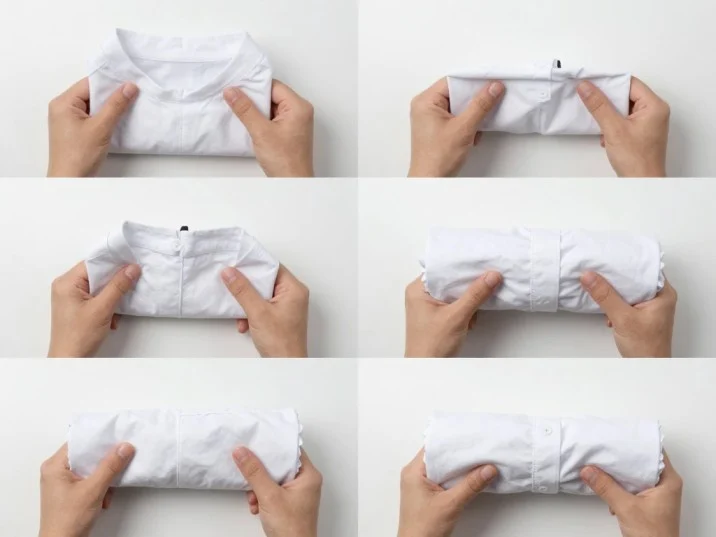
Different trips call for different shirt-packing methods. Most frequent travelers use a mix of these techniques depending on luggage type and wrinkle-prevention needs.
Flat Fold with Collar Support
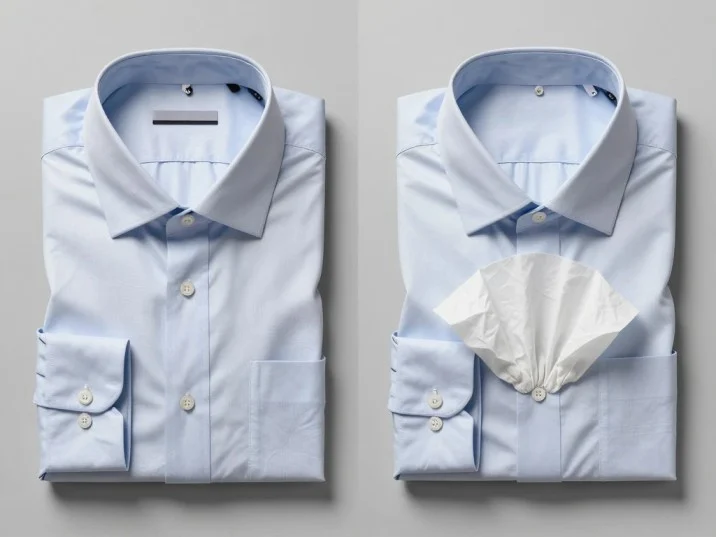
This is the standard method for structured suitcases. Button the top button and every other button to keep the shirt flat. Lay it face-down, fold the sleeves across the back, fold the sides inward, then fold the shirt into thirds. For extra wrinkle protection, place tissue paper or a dry cleaner’s plastic bag between folds to reduce friction and crease formation.
Ranger Roll
Originally developed by the military, the ranger roll creates a compact bundle that saves space and minimizes sharp creases. Fold the bottom hem up a few inches, fold the sides toward the center, align the sleeves along the body, then roll tightly from the collar downward. Secure the roll with the folded hem. This method works especially well in backpacks and duffel bags.
Bundle Wrapping
One of the most effective wrinkle-prevention techniques for longer trips. Instead of folding shirts individually, wrap them around a soft core such as a packing cube or rolled clothing. The curved folds reduce crease points, helping dress shirts stay smooth for several days. It takes more time but delivers excellent results.
Packing Cubes with File Folding
Fold shirts flat and place them vertically inside a packing cube rather than stacking them horizontally. This keeps shirts organized, reduces shifting during travel, and allows easy access without disturbing the entire stack.
Choosing the right method depends on your luggage, trip length, and how wrinkle-free your shirts need to remain.
Quick Reference: Folding Methods by Trip Type
| Method | Best For | Bags | Wrinkle Level |
| Flat fold with tissue | Short trips, structured suitcase | Hard-shell, checked | Low |
| Ranger roll | Duffel, backpack, carry-on | Soft bags, overhead bin | Low-medium |
| Bundle wrapping | Multi-day trips, multiple shirts | Any | Very low |
| Packing cube file fold | Organization-focused travel | Any structured bag | Low |
Results vary based on fabric, compression level, and trip duration.
The Best Fabrics for Travel Dress Shirts
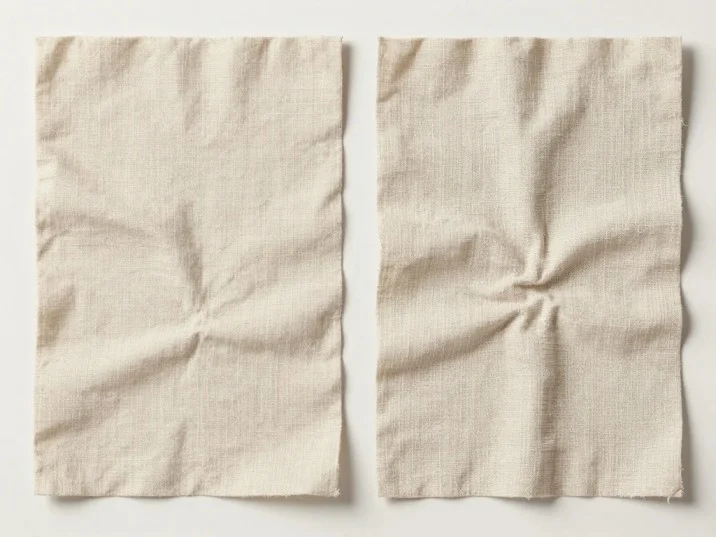
Fabric choice often matters more than folding technique when it comes to preventing travel wrinkles. Even the best packing method can’t keep some fabrics perfectly smooth during a long trip.
Performance Fabric Blends
Polyester, nylon, and spandex blends offer the best wrinkle resistance. They’re ideal for travelers who want shirts to look presentable straight from a suitcase. While they don’t breathe as naturally as cotton, many modern travel shirts combine a professional appearance with excellent wrinkle resistance.
Wrinkle-Resistant Cotton
Non-iron and wrinkle-resistant cotton shirts provide a great balance between comfort and practicality. Special treatments help reduce creasing while preserving the feel and breathability of natural cotton. They’re a popular choice for business travelers and work well for meetings, conferences, and dinners.
Cotton-Polyester Blends
These blends combine the comfort of cotton with the wrinkle resistance of polyester. Available at nearly every price point, they’re reliable for trips lasting several days and require less maintenance than pure cotton.
100% Cotton
Untreated cotton poplin and broadcloth look and feel excellent but wrinkle easily in luggage. Packing methods such as ranger rolling or bundle wrapping can help, but most travelers should expect to steam or iron these shirts after arrival.
Linen
Linen is the most wrinkle-prone fabric of all. While its relaxed, textured appearance works well for beach vacations, resort wear, and casual summer trips, it’s usually not the best choice for business travel or occasions that require a crisp, polished look.
Bottom Line: For the easiest travel experience, choose performance fabrics, wrinkle-resistant cotton, or cotton-poly blends. Fabric selection often has a greater impact on wrinkle prevention than packing technique alone.
How to Pack Dress Shirts in a Carry-On vs. Checked Luggage
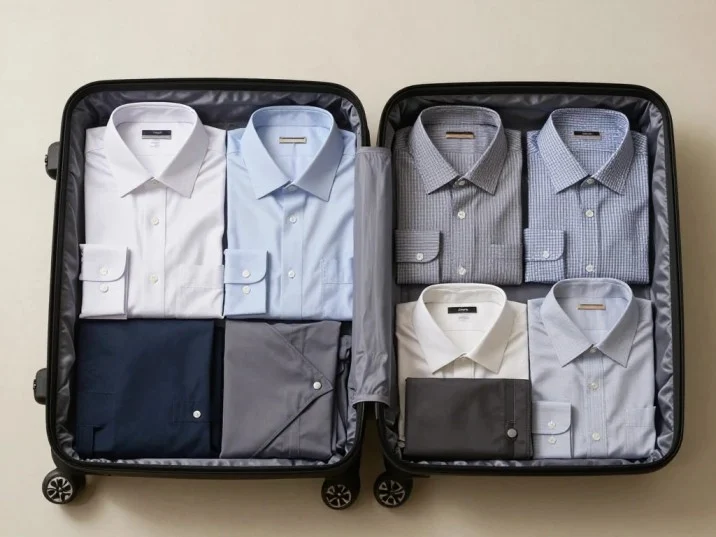
The packing approach differs meaningfully between carry-on and checked luggage because the physical conditions during travel are different. Carry-on bags live in overhead bins where compression is moderate and consistent. Checked bags go through baggage handling, conveyor systems, and cargo holds where compression can be significant and unpredictable.
For carry-on packing, dress shirts packed flat or in a ranger roll fit well in most standard carry-on suitcases (typically 21–22 inches). Place dress shirts near the top of the bag directly under the lid when the bag lies flat rather than at the bottom where other items stack on top of them. A hard-shell carry-on with a dedicated flat-pack side makes shirt management particularly easy, as shirts stay separated from shoes, toiletries, and other items that can create pressure points.
For checked luggage, the bundle wrapping method provides the most protection because it distributes compression evenly rather than concentrating it along fold lines. Alternatively, use a rigid shirt packing board a flat plastic insert that keeps shirts in structured flat-fold position and protects them from the irregular shapes of surrounding items pressing in. Avoid packing dress shirts against hard-edged items like shoes, electronics, or toiletry bags without a buffer layer between them.
Insider tip: Pack your dress shirts last, directly against the interior lid of your suitcase. When you close and zip the bag, the lid side compresses the contents from the outside in shirts on the lid side experience the least movement and pressure change during transit. Shoes, toiletries, and heavy items belong on the base (wheel) side.
Shirt Stays, Collar Stays, and Packing Accessories That Actually Help
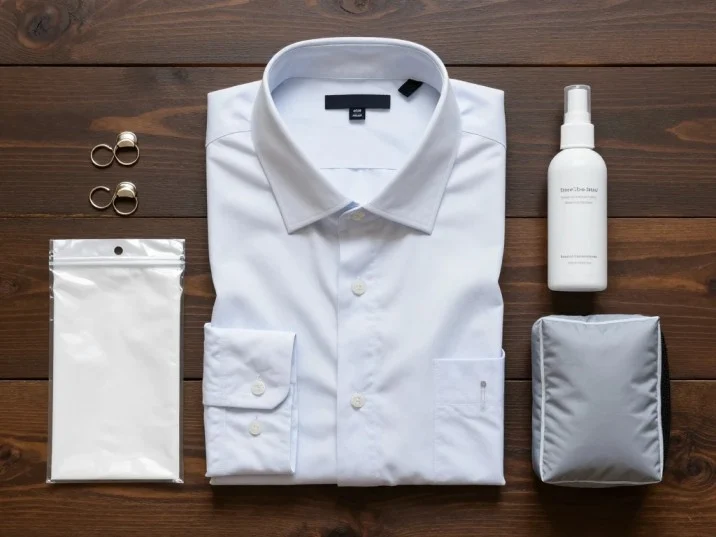
A few simple accessories can significantly improve how dress shirts look after travel.
Collar Stays
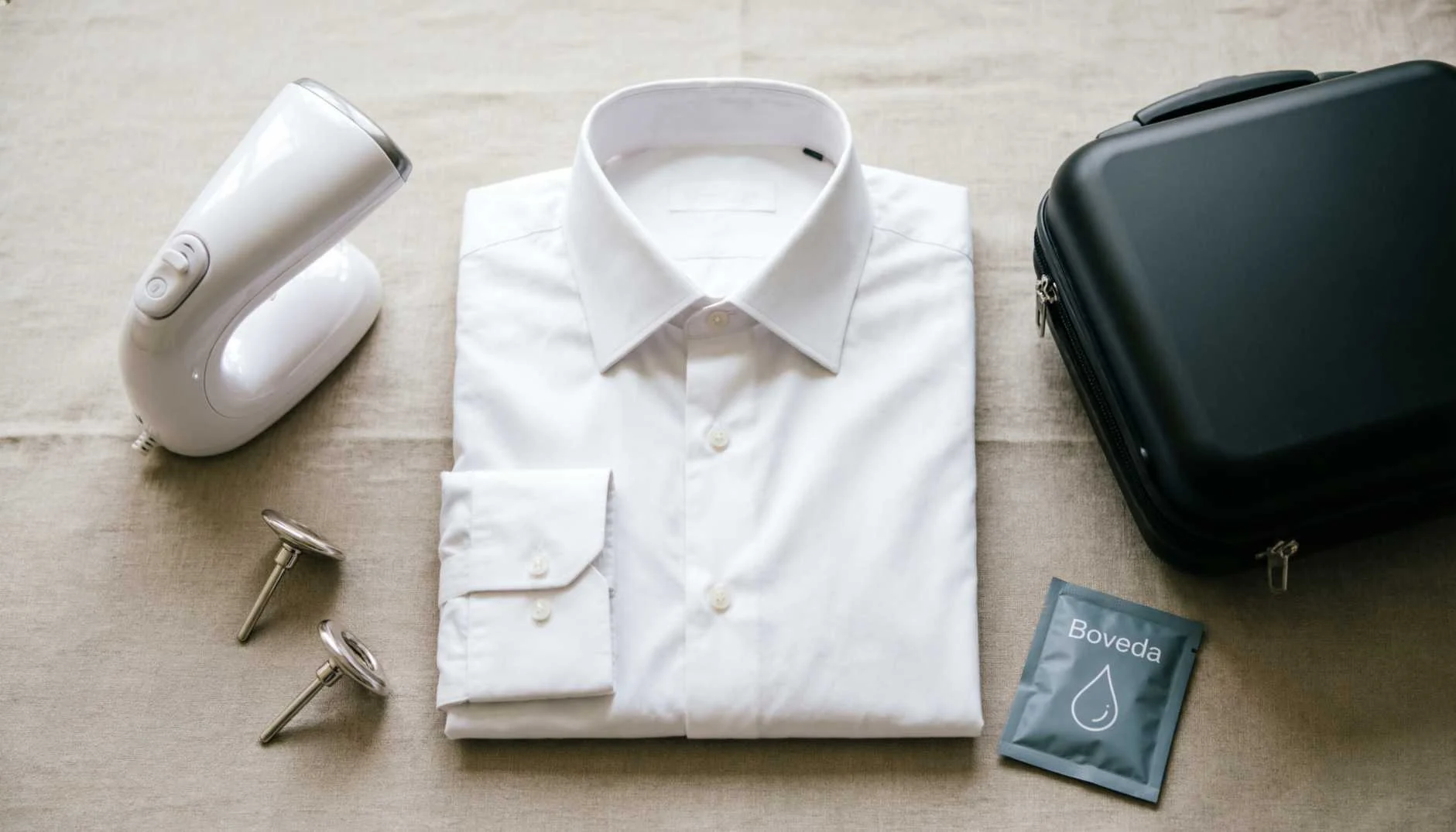
These small metal or plastic inserts fit inside collar pockets and help keep collar points sharp and flat. Many travelers forget to reinsert them after washing, but they make a noticeable difference in maintaining a polished appearance.
Dry Cleaner Plastic Bags
Placing a plastic dry-cleaning bag between folded shirts reduces friction and helps prevent deep crease lines from forming during travel. It’s an inexpensive and highly effective wrinkle-prevention trick.
Shirt Packing Boards
Packing boards are thin, rigid inserts that keep shirts neatly folded and supported inside luggage. They’re most useful for travelers carrying multiple dress shirts in checked baggage, though some people find them too bulky for shorter trips.
Packing Cubes
Standard packing cubes help organize shirts and prevent shifting during transit. However, avoid heavily compressing dress shirts. Compression cubes work well for casual clothing but can create additional wrinkles in dress shirts by applying excessive pressure.
Wrinkle Release Spray
A travel-sized wrinkle release spray is one of the most practical tools for business travelers. Simply mist the shirt lightly, smooth the fabric with your hands, and hang it for 10–15 minutes. It won’t replace proper packing, but it quickly removes minor wrinkles without needing an iron.
Bottom Line: Collar stays, plastic garment bags, standard packing cubes, and wrinkle release spray are inexpensive accessories that can make a noticeable difference in keeping dress shirts looking fresh and professional while traveling.
Hotel Room Strategies for Refreshing Packed Dress Shirts
Packing your dress shirt correctly is only half the battle. What you do after arriving at your destination can make a big difference in how wrinkle-free it looks.
Use Bathroom Steam
Hang your shirt on a hanger in the bathroom while running a hot shower. The steam helps relax fabric fibers, allowing wrinkles to loosen naturally within 10–15 minutes. This method works best on cotton and cotton-blend shirts. Keep the shirt away from direct water to avoid damp spots.
Use the Hotel Iron Properly
Most hotels provide an iron and ironing board. For best results, iron the inside of the collar, cuffs, and button placket to avoid creating shiny marks on the fabric. Using a thin cloth between the iron and the shirt can provide extra protection.
Consider a Travel Steamer
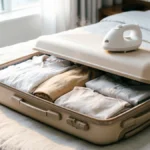
Portable travel steamers are a favorite among frequent business travelers. Lightweight and compact, they remove wrinkles quickly, work on nearly all fabrics, and eliminate the risk of iron marks. If you regularly travel with several dress shirts, a travel steamer can be a worthwhile investment.
Unpack Immediately
One of the simplest and most effective strategies is to remove dress shirts from your luggage as soon as you arrive. Hanging them right away allows gravity to help relax minor wrinkles. After four to six hours on a hanger, many creases will soften noticeably, even without steaming or ironing.
Bottom Line: Steam, careful ironing, travel steamers, and immediate unpacking are easy ways to keep dress shirts looking fresh and professional throughout your trip.
What to Do When You Can’t Iron or Steam
Sometimes the iron is broken, the steam trick isn’t working, or you simply don’t have time. A few alternative approaches handle light-to-moderate wrinkles adequately when standard methods aren’t available.
Lightly mist the shirt with water from the bathroom sink using your hands, then smooth the fabric firmly with your palms and fingers, working from the collar down. Hang the shirt and allow it to air dry most synthetic and blend fabrics smooth out significantly with this approach. On cotton, the results are less dramatic but still useful for reducing surface creasing.
A flat hair dryer works as a makeshift steamer in a pinch. Hold it six to eight inches from the fabric on a medium heat setting, smooth the fabric with your free hand as you go, and move continuously to avoid heat concentration in one spot. This works best on synthetic and blend fabrics; use low heat on cotton to avoid scorching.
Wrinkle release spray combined with vigorous smoothing and hanging is the most reliable emergency option. Keep a travel-sized bottle in your toiletry kit for exactly this situation.
For a genuinely critical meeting or event where a wrinkled shirt isn’t acceptable, hotel concierge pressing available at most full-service hotels within one to two hours is worth the cost. Many Marriott, Hilton, Westin, and Hyatt properties offer same-day pressing for a modest fee (verify pricing directly with the property). In New York, Chicago, Los Angeles, and other major US cities, on-demand clothing services can sometimes deliver a pressed shirt to your hotel room when time is genuinely critical.
Three Common Dress Shirt Packing Mistakes and How to Fix Them
Mistake 1: Folding along the button placket. The button placket creates a natural fold line that the shirt “wants” to follow but folding there puts all the compression force directly on the front of the shirt in the most visible location. Fix: Button the top button and fold the shirt so the placket stays flat and centered. Never fold along the button line. When folding sleeves across the back, the front should remain fully flat.
Mistake 2: Overpacking and relying on compression to “make it work.” Travelers who stuff more shirts than their bag comfortably holds, then force the zipper closed, create maximum crease conditions. More compression equals more crease depth. Fix: Pack one fewer shirt than you think you need and plan to use hotel laundry service or a local laundromat for longer trips. Most US hotels offer next-day laundry service; many have self-service laundry facilities. In cities like New York, San Francisco, and Chicago, wash-and-fold laundry pickup services are widely available and affordable.
Mistake 3: Packing shirts immediately after laundering without allowing them to cool. Shirts that come out of a dryer warm are in a temporarily relaxed state the heat has released fiber tension. If you fold and pack them immediately, they set into their folded position as they cool in the bag. Fix: Hang laundered shirts and allow them to cool completely and hang straight for at least thirty minutes before folding and packing. Even better, hang them overnight before a next-day departure.
Underrated Alternatives to Traditional Dress Shirt Packing
Three approaches that experienced travelers use but rarely appear in standard packing guides:
The suits carrier for shirts. A hanging garment bag the kind designed for suits accommodates four to six dress shirts on hangers inside a folded carrier that checks as luggage or carries on. The shirts never fold; they travel flat on hangers. On arrival, you unzip and hang. This approach eliminates travel wrinkling almost entirely for dress shirts, works well for travelers attending formal events where shirt presentation is critical, and suits trips where checking luggage is already planned. The trade-off is that a garment bag takes up its own checked bag slot.
Buying wrinkle-resistant shirts at your destination. For domestic travel to major US cities a business trip to Boston, Seattle, or Dallas several national retailers with same-day availability (J.Crew, Banana Republic, and others) carry wrinkle-resistant dress shirts you could theoretically purchase at your destination if a packing failure happens. This isn’t a primary strategy, but knowing you have a fallback removes anxiety from the packing process.
Sending shirts ahead via shipping. For multi-week international trips or significant events where presentation is paramount a destination wedding in Savannah, a major conference in Las Vegas shipping dress shirts ahead to the hotel via FedEx or UPS eliminates the packing problem entirely. Most hotels will hold packages for arriving guests when coordinated through the concierge. The shirts travel flat in a box, arrive unwrinkled, and the return shipping cost is manageable relative to the value of the shirts and the importance of the occasion.
FAQ:
What is the best way to fold a dress shirt for a suitcase?
The best method for most travelers is the flat fold with collar support and a tissue paper or plastic dry-cleaning bag between layers. Button the top button, lay the shirt face-down, fold sleeves across the back, fold the shirt in thirds from the bottom, and place it directly against the lid of your suitcase. For soft bags, the ranger roll minimizes creases even further by eliminating sharp fold lines entirely.
How do you pack a dress shirt without wrinkles?
Pack dress shirts using the bundle wrapping method for maximum wrinkle prevention wrap multiple shirts around a soft central core rather than folding each one independently. Combined with wrinkle-resistant fabric (non-iron cotton or performance blends), this method delivers shirts in near-pristine condition through multi-day travel. On arrival, unpack and hang shirts immediately to let gravity finish the job over a few hours.
What fabrics wrinkle least when packed in a suitcase?
Performance fabric blends (polyester-nylon or polyester-spandex) wrinkle least of any dress shirt fabric. Non-iron treated cotton is the best natural-fiber option. Cotton-polyester blends (60/40 or similar) perform reliably for trips of one to four days. Untreated 100% cotton and linen wrinkle significantly during travel and require ironing or steaming on arrival without exception.
Should I roll or fold dress shirts for travel?
Rolling specifically the ranger roll technique outperforms standard flat folding for most soft-bag travel because it eliminates sharp fold lines. However, rolling can create subtle wrinkles along the roll direction on fine cotton fabrics. Bundle wrapping outperforms both methods for multi-day travel with multiple shirts. For hard-shell suitcases, a careful flat fold with tissue paper between layers performs comparably to rolling and maintains collar shape better.
How do I keep my dress shirt collar from getting crushed in a suitcase?
Keep collar stays inserted in the collar stay pockets to maintain collar point shape. When folding, place a small rolled piece of tissue paper or a sock inside each collar point to support it. If using the flat fold method, lay the collar flat and open rather than folding it down. On arrival, hang the shirt and use a travel steamer on the collar first collars recover from compression faster than shirt bodies with targeted heat.
Can I pack a dress shirt in a carry-on bag and arrive wrinkle-free?
Yes, consistently. Use a ranger roll or bundle wrapping method, choose wrinkle-resistant fabric (non-iron cotton or a performance blend), pack the shirt against the lid of your carry-on, and unpack immediately on arrival. A carry-on shirt arrives in better condition than a checked shirt because overhead bin compression is more controlled than cargo hold conditions. Light wrinkles from carry-on travel disappear after thirty minutes of hanging in most cases.
Is a travel steamer or hotel iron better for dress shirts while traveling?
A portable travel steamer is better for most travelers. Steamers work on all fabrics without the risk of iron marks or shine, take two to three minutes per shirt versus five to ten for ironing, and handle travel wrinkles effectively without requiring a flat ironing surface. Hotel irons produce crisper results on heavy cotton and are more effective on stubborn collar creases, but they carry a higher risk of damage on delicate fabrics. Carry both a travel-sized wrinkle release spray and a steamer for maximum flexibility.
Three Things That Change How You Pack Dress Shirts Forever
First, fabric selection is the highest-leverage decision you make. The best folding technique applied to a natural linen shirt still produces a wrinkled shirt.
The same technique on a non-iron cotton or performance blend shirt arrives presentable with minimal intervention.
Before your next trip, check the fabric content of the dress shirts you’re planning to pack and if travel is a consistent part of your professional life, invest in a few shirts specifically designed for it.
Second, unpacking on arrival matters as much as folding at departure. The travelers who consistently have the best-looking shirts at their destination don’t just pack well they hang their shirts the moment they check in and let gravity do the final work.
This single habit, added to a solid folding technique, closes the gap between “pretty good” and “actually wrinkle-free.”
Third, the ranger roll and bundle wrapping methods are genuinely worth learning even if they feel awkward at first.
Both take practice to do quickly, but both deliver measurably better results than standard flat folding in real travel conditions particularly in soft bags, backpacks, and carry-ons where shirts don’t lie perfectly flat.
Pack well, arrive sharp, and spend the time you save on ironing actually enjoying wherever you’ve landed.

Ben Fogle believes that true adventure begins where the pavement ends. After spending years documenting extreme environments, rowing across oceans, and trekking through frozen landscapes, he mastered the art of wilderness travel. For Travelmarse, Ben constructs highly detailed guides on deep-nature packing lists, wildlife safety, and sustainable eco-tourism. He breaks down intimidating, rugged expeditions into clear, step-by-step roadmaps so everyday travelers can safely connect with the natural world.