Standing in front of an open suitcase at midnight, tape measure in hand, wondering if that “22-inch” bag you bought two years ago will actually clear check-in in Dubai or Doha next week it’s a familiar kind of stress. Luggage size for international travel is one of the most confusing parts of planning a trip, mostly because there is no single global rule, and the number on a suitcase tag rarely matches what an airline actually enforces.
This guide breaks it down plainly: checked and carry-on size limits in centimeters and inches, weight rules for major international carriers including Emirates, Qatar Airways, and IndiGo, what “28-inch” or “23kg” actually means in real life, and how to avoid the most expensive baggage mistakes travelers make. Everything here is organized so you can jump straight to your question, get a direct answer, and get back to packing.
Quick answer:
Most airlines set international checked baggage at 23 kg (50 lb) per bag with a maximum linear size of 158 cm (62 in) length + width + height combined. Carry-on bags usually top out around 55 x 40 x 20 cm (22 x 16 x 8 in) and 7-10 kg. Exact limits still vary by airline, fare, and route, so always confirm before you fly.
Quick Facts Table
| Bag Type | Typical Size Limit | Typical Weight Limit |
| Carry-on (cabin bag) | 55 x 40 x 20 cm (22 x 16 x 8 in) | 7-10 kg (15-22 lb) |
| Personal item | 40 x 30 x 15 cm (16 x 12 x 6 in) | Usually no separate weight cap |
| Standard checked bag | 158 cm / 62 in total linear (L+W+H) | 23 kg (50 lb) |
| Large/oversized checked bag | Up to 158-300 cm depending on airline | 23-32 kg per piece |
| Suitcase equivalent | Roughly a 24-26 inch hardside case |
These are general industry benchmarks, not a universal law. Always check your specific airline and fare before packing, since low-cost fares often shrink these numbers significantly.
Check-In Baggage Size for International Flights
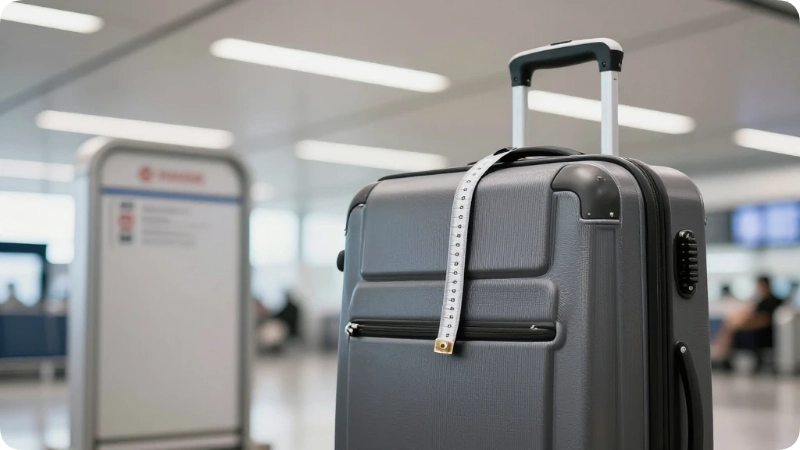
Check-in (checked) baggage size for international flights is usually capped at 158 cm (62 inches) total linear dimension; that’s length plus width plus height added together, wheels and handles included. Weight is typically 23 kg (50 lb) in economy, though this ranges from 20 kg to 32 kg depending on the airline, fare class, and route.
In physical suitcase terms, 158 cm total linear usually lines up with a 26 to 28-inch hardside checked bag. Go bigger than that, and you risk oversize fees even if the bag is well under the weight limit.
Some airlines (Emirates, Qatar Airways) allow up to 300 cm total dimensions on certain routes, but restrict it to 158 cm on flights to and from the Americas, Africa, or specific airports. The route matters as much as the airline.
Carry-On Luggage Size for International Flights
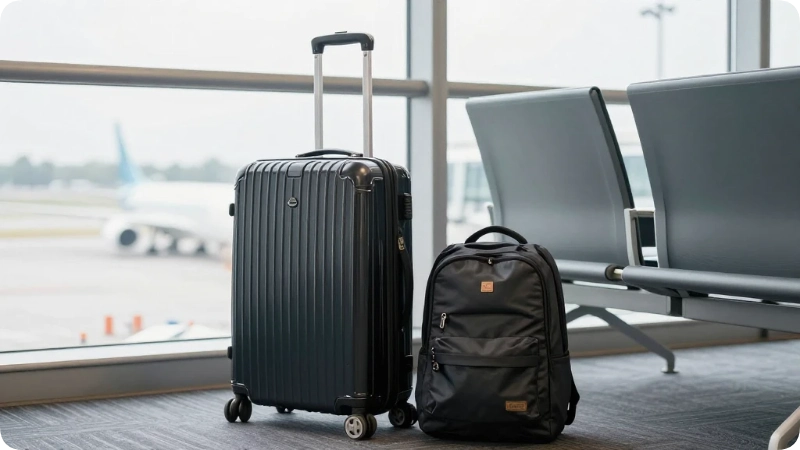
Carry-on luggage for international flights generally must not exceed about 55 x 40 x 20 cm (22 x 16 x 8 in), weighing 7-10 kg, though this is not a single worldwide standard. IATA publishes a reference size, but individual airlines set their own rules, and enforcement has gotten noticeably stricter in 2026 with automated gate scanners at more airports.
U.S. full-service carriers (American, Delta, United, Alaska, JetBlue) commonly use 22 x 14 x 9 in (56 x 36 x 23 cm), with no strict weight cap enforced at the gate. Middle Eastern and Asian carriers, including Emirates and Qatar Airways, weigh cabin bags closely and enforce a 7 kg limit in economy.
Practical rule: measure your bag fully packed, with wheels and handles extended, against your specific airline’s published limit, not a generic “22 inch” assumption.
Luggage Size for International Travel in CM and Inches
In metric, standard international checked luggage tops out around 158 cm total (length + width + height); in imperial, that’s 62 inches. Carry-on bags typically run 55 x 40 x 20 cm, or roughly 22 x 16 x 8 inches. Knowing both units matters because U.S. retailers list inches while most international airlines publish centimeters.
| Measurement | Centimeters | Inches |
| Standard checked bag (linear total) | 158 cm | 62 in |
| Typical carry-on | 55 x 40 x 20 cm | 22 x 16 x 8 in |
| Large checked bag (some airlines) | up to 300 cm | up to 118 in |
| Personal item | 40 x 30 x 15 cm | 16 x 12 x 6 in |
A quick conversion habit: 1 inch = 2.54 cm. A 28-inch suitcase converts to roughly 71 cm in height alone, so add its width and depth before assuming it fits any linear-total rule.
Luggage Weight Limit for International Flights
The most common international checked-baggage limit is 23 kg (50 lb) per bag in economy class. Business and first class often allow up to 32 kg (70 lb).
Budget fares may offer only 15–20 kg. Premium fares on full-service airlines can provide 30–35 kg.
Most airlines do not allow one checked bag to exceed 32 kg (70 lb). If your total allowance is higher, split the weight between two bags. This also helps baggage handlers work safely.
International carry-on limits can be stricter than those in the U.S. Many Middle Eastern, Asian, and European airlines enforce 7–10 kg limits. Staff may weigh your bag at check-in or the gate.
Several U.S. airlines focus more on carry-on size. They may check whether your bag fits inside the overhead-bin sizer instead of weighing it.
International Flight Baggage Weight Limit: IndiGo
IndiGo’s international checked-baggage allowance varies by route and fare. It typically ranges from 15 to 30 kg. Each bag has a maximum weight of 32 kg.
Cabin baggage is limited to 7 kg. The maximum cabin-bag size is 55 × 35 × 25 cm. Passengers can also carry one personal item weighing up to 3 kg. Examples include a laptop bag or handbag.
As a low-cost carrier, IndiGo may offer fares with no free checked baggage. You may need to buy baggage separately. Paying for baggage at the airport can also cost more.
Popular international routes, including Bangkok, Bali, Nepal, Male, and Mauritius, often include around 20 kg.
Check your fare before booking. The baggage allowance can vary by route. Do not assume that every international IndiGo fare includes 30 kg.
Luggage Size for International Travel: Emirates

Emirates checked baggage usually ranges from 23 to 35 kg, depending on your fare and cabin. On weight-based routes, the maximum total size is around 203 cm. Flights to and from the Americas may use a 150 cm per-piece limit.
Economy passengers can usually bring one cabin bag up to 7 kg. The maximum cabin-bag size is 55 × 38 × 20 cm.
Emirates uses two baggage systems based on your route:
- Weight concept: Most routes use a total weight allowance. You can split this allowance across multiple bags. Each bag must not exceed 32 kg.
- Piece concept: Flights to and from the Americas use a set number of bags. Flights originating in Africa may also use this system. Economy often includes two bags of up to 23 kg each. Each piece usually has a 150 cm size limit.
Emirates Skywards Silver, Gold, and Platinum members may receive extra baggage on weight-based routes. Your fare also matters. An Economy Special ticket can have a lower allowance than Economy Flex Plus.
Luggage Size for International Travel: Qatar Airways
Qatar Airways checked baggage is limited to 158 cm total linear dimensions on flights to and from Africa or the Americas. Most other international routes allow up to 300 cm. The maximum weight for one bag is 32 kg.
Cabin baggage includes one bag up to 7 kg. Its maximum size is 50 × 37 × 25 cm. Passengers may also bring a personal item.
Qatar Airways uses different checked-baggage allowances by fare. Economy Lite offers around 20 kg, while Classic offers 25 kg. Convenience provides about 30 kg, and Comfort offers around 35 kg. Business usually allows 40 kg, while First allows up to 50 kg.
Routes to Africa and the Americas use a piece-based baggage system. Depending on the fare, passengers may receive one or two bags. Each bag can weigh up to 23 kg.
Passengers departing from the United States can bring one carry-on bag and one personal item. This applies across cabin classes, including Business and First.
What Size Luggage Is Allowed on International Flights?
International flights often allow one carry-on bag around 55 × 40 × 20 cm. Economy passengers may also get one checked bag with 158 cm total linear dimensions.
Larger bags may incur oversize baggage fees. Bags above roughly 300 cm total may be refused and require cargo shipping.
There is no single global rule for baggage sizes. Your airline, fare class, and route determine the exact allowance.
For example, Qatar Airways may include baggage on one fare. A cheaper Lite fare may charge extra for the same route.
The safest option is to check your e-ticket or booking confirmation. It shows your exact baggage allowance. Do not rely only on general online guides when packing.
What Is the Best Size Suitcase for International Travel?
For most international trips, a 24- to 26-inch checked suitcase offers the best balance of space and airline compliance. Both hardside and softside options work well. Most fit comfortably within the common 158 cm linear limit. You will also have enough room for souvenirs. Pair it with a compliant carry-on (around 20-22 inches) for a two-bag system that covers most trip lengths.
Who a 24-26 inch checked bag suits best:
- Trips of 7-14 days
- Travelers checking one bag per person
- Anyone flying airlines with strict 158 cm limits (most Middle Eastern and Asian carriers)
Who should size down instead:
- Carry-on-only travelers (choose 20-22 inch)
- Short trips under a week
- Travelers on airlines charging by weight rather than size, where a lighter, smaller bag saves money either way
A 28-inch or larger suitcase is better reserved for long-term travel, relocation, or family trips splitting weight across fewer bags, not everyday international vacations.
New Baggage Size Rules for Airlines in 2026
There is no single new global carry-on or checked baggage size rule for 2026, despite frequent online claims. What has genuinely changed is enforcement: more airports now use automated AI gate-scanners that measure bags in seconds, replacing the old metal sizers travelers could sometimes squeeze a bag into.
IATA’s official reference dimension for cabin bags remains 56 x 45 x 25 cm (22 x 18 x 10 in) as a general guideline, but conditions of carriage stay airline-specific. U.S. legacy carriers still use 22 x 14 x 9 in, while many European and Middle Eastern airlines use smaller cabin bag limits around 55 x 40 x 20 cm.
What did tighten in 2026:
- Stricter, more consistent gate enforcement using digital scanners at major hubs
- Growing airline pressure toward smaller “one bag fits all” cabin sizes, though no universal mandate has been adopted
- Continued airline-specific personal item enforcement, with under-seat bags increasingly measured, not just eyeballed
Because policies shift by airline and even by fare within the same airline, verify your specific carrier’s current baggage page within a few weeks of departure, rather than trusting a fixed number for “2026 rules” broadly.
Is 28-Inch Luggage Too Big for International Check-In?
A 28-inch suitcase is generally accepted as checked baggage on international flights, but it sits close to or over the 158 cm (62 in) linear limit many airlines enforce, so it can trigger oversize fees on strict carriers. It’s fine on airlines using generous weight-concept rules; it’s risky on airlines with fixed piece-size caps.
A 28-inch bag’s height alone is about 71 cm; once you add typical width (about 45-48 cm) and depth (about 28-30 cm), the total linear dimension often lands between 144 cm and 155 cm, usually inside 158 cm, but with little margin.
Fixes if you’re borderline:
- Choose a slimmer 28-inch model (lower depth) rather than a wide, boxy one
- Check your specific airline’s per-piece limit, not just the general 158 cm benchmark
- If flying Emirates or Qatar Airways to the Americas or Africa, confirm the tighter 150-158 cm piece-concept rule applies to your route.
Is 28-Inch Luggage Large or XL?
A 28-inch suitcase is generally classified as “large” or “XL” in most luggage lines, sitting above the “medium” 24-26 inch category and typically holding 90-110 liters, enough for two to three weeks of clothing or family packing. It’s the biggest size most airlines will accept as a single checked bag without extra fees.
Luggage brands aren’t perfectly consistent with naming, but as a rule of thumb:
| Size | Common Label |
| 18-20 in | CCabin/carry-on |
| 22-24 in | Medium |
| 26-28 in | Large |
| 29-32 in | XL / extra-large |
If a retailer lists 28 inches as “XL,” that’s a labeling choice, not a universal standard. Check the bag’s actual centimeter dimensions against your airline’s limit instead of trusting the size name alone.
Is 29-Inch Luggage Oversized?
A 29-inch suitcase is often oversized by airline standards, since its total linear dimensions frequently exceed 158 cm, the common international checked-bag limit. Many airlines will still accept it, but you should expect an oversize or excess baggage fee on strict carriers rather than assume it flies free.
At 29 inches tall, with typical width and depth added, total linear measurements commonly reach 155-165 cm, putting the bag right on the edge, sometimes over, sometimes under, depending on the specific model’s shape.
A 29-inch case typically holds 35-40 kg worth of packed volume by capacity alone, but remember: even if it fits inside the bag, the airline’s per-bag weight cap (usually 23-32 kg) still applies separately from size.
Can you check a 29-inch suitcase internationally? Usually yes, but confirm your airline’s specific linear-dimension limit first. A 29-inch bag that clears one airline’s sizer may be charged as oversized on another.
Is a 30-Inch Suitcase Too Big Internationally?
A 30-inch suitcase can exceed the standard 158 cm international checked-baggage limit. It may also trigger oversize fees. Some airlines may refuse it if it exceeds their bulk-luggage limits.
This suitcase size is better for relocation, extended stays, or luggage shipping. It is less suitable for a standard vacation checked bag.
A 30-inch suitcase often has total linear dimensions of 165 cm to 185 cm. That is above the common 158 cm limit. Qatar Airways, Emirates, and many international airlines use similar baggage limits on some routes.
If you need extra luggage, consider luggage shipping services. You can also split your belongings between two medium-sized checked bags. This can cost less than one large oversize bag. It is also easier to carry and handle.
Is 24-Inch Luggage Medium or Large?
A 24-inch suitcase is generally classified as “medium,” offering roughly 60-75 liters of packing space, enough for a week to ten days of clothing for one traveler. It comfortably clears the 158 cm linear limit used by most international airlines, with plenty of margin to spare.
For context, a 24-inch bag typically measures around 61 x 40 x 26 cm, giving a linear total near 127 cm, well under the common threshold, which is why it’s a popular “safe” checked-bag choice for international trips.
Best suited for: one-week international trips, couples splitting a single larger bag, or travelers who prefer to check one bag rather than carry on.
26-Inch vs 28-Inch Luggage: What’s the Difference?
The main difference between a 26-inch and 28-inch suitcase is roughly 15-20 liters of extra packing space and about 2-4 kg of added empty-bag weight, with the 28-inch model sitting much closer to airline size limits. A 26-inch bag is the safer, more universally compliant option for international travel.
| Feature | 26-Inch | 28-Inch |
| Typical capacity | 90-100 L | 100-120 L |
| Typical linear total | ~135-145 cm | ~144-155 cm |
| Best for | 10-14 day trips, most airlines | Long trips, families, airlines with generous weight limits |
| Oversize fee risk | Low | Moderate |
Should you get a 26 or 28? If you fly a mix of airlines, including budget or Middle Eastern carriers with strict piece limits, go with 26 inches. If you mainly check bags with airlines using generous weight-concept rules and travel for 3+ weeks at a time, 28 inches gives more room meaningfully.
25-Inch vs 29-Inch Suitcase: Which Should You Choose?
A 25-inch suitcase suits most international trips of one to two weeks and stays safely under standard size limits; a 29-inch suitcase is better reserved for extended travel, since it often runs close to or over the 158 cm cap. For most travelers booking a typical vacation, 25 inches is the more airline-friendly, easier-to-manage choice.
Choose 25-inch if:
- You’re checking one bag for a 1-2 week trip
- You want reliable compliance across multiple airlines
- You’ll be lifting the bag yourself onto trains, buses, or stairs
Choose 29-inch if:
- You’re moving, relocating, or traveling for a month or longer
- You’re splitting a family’s belongings across fewer bags
- You’ve confirmed your specific airline’s per-piece size limit accommodates it
What Luggage Size Fits a 23kg International Allowance?
A 23kg international baggage allowance typically fits inside a 24 to 26-inch checked suitcase, since weight, not size, is usually the limiting factor at that capacity for most travelers’ packing habits. You could technically fit 23kg into a smaller 22-inch bag or a larger 28-inch one; the weight limit stays the same either way.
What 23kg roughly looks like in real packing terms:
- About 15-18 folded outfits (mixed clothing types)
- Or 2 pairs of shoes, a light jacket, toiletries, and 10-12 outfits
- Roughly the weight of two carry-on suitcases combined
The bag’s empty weight counts toward your 2323 kg too. A heavy hardside case can eat 4-5 kg of your allowance before you’ve packed a single item, so lightweight bags genuinely buy you more usable packing weight.
What Does “2 Bags at 23kg” Mean?
“2 bags at 23kg” means your airline allows two separate checked pieces, each individually weighed and each capped at 23kg, not one combined 46kg bag. This is the “piece concept” used by many international carriers, including Emirates and Qatar Airways on Americas and Africa routes.
This matters because you cannot pack 30kg in one bag and 16kg in the other and call it “within 46kg total”; most piece-concept airlines will charge an overweight fee on the 30kg bag specifically, even though your combined total is under the overall allowance.
Can you put 30kg in two bags? Generally no, if each bag is individually capped at 23kg, you’d need to redistribute so neither bag exceeds its own limit, or pay for extra weight on whichever bag goes over.
Can I Carry 3 Pieces of Luggage on an International Flight?
Most economy international fares allow one to two checked bags for free; a third piece is almost always an extra charge, typically $100-$200 USD depending on the airline and route. Business and First Class passengers commonly get two to three pieces included as part of a more generous baggage allowance.
Airlines that use the piece concept (Emirates, Qatar Airways on Americas/Africa routes) make third-bag pricing especially clear, since it’s charged per additional piece rather than by weight. Weight-concept airlines instead let you spread your total kilogram allowance across as many bags as you like as long as no single bag exceeds the per-bag maximum, usually 32 kg.
If you genuinely need three checked bags: pre-purchase the extra piece online before departure is consistently cheaper than paying at the airport counter.
What Is the Maximum Size for Checked-In Luggage on Flights?
The absolute maximum size most international airlines will check as luggage is around 300 cm (118 in) total linear dimensions, beyond which items must be shipped as air cargo rather than passenger baggage. The far more common everyday maximum, used for standard passenger bags, is 158 cm (62 in).
| Route Type | Typical Max Checked Bag Size |
| Standard international economy | 158 cm (62 in) |
| Generous weight-concept routes (Emirates, Qatar Airways, non-Americas/Africa) | up to 300 cm (118 in) |
| Sports equipment / oversized items | Airline-specific, often 200-300 cm |
What’s the biggest size luggage you can check internationally? In practice, 158 cm covers standard suitcases; 300 cm is reserved for bulky sports gear, musical instruments, and similar oversized iitemsot a ssuitcaseyou’d pack for a normal vacation.
What Is the Maximum Size for a Personal Item Bag?
A personal item bag for international flights is typically limited to around 40 x 30 x 15 cm (16 x 12 x 6 in), small enough to slide fully under the seat in front of you. This is separate from and in addition to your carry-on bag on most full-service airlines.
Common personal items include a laptop bag, small backpack, purse, or briefcase. On budget carriers, the personal item is sometimes your only free cabin allowance, with the larger overhead-bin carry-on costing extra, so check which category your fare actually includes before assuming both are free.
In 2026, personal item sizes are being measured more consistently at the gate on several carriers, closing a loophole where oversized “personal items” were effectively used as free second carry-ons.
How to Measure Luggage Size
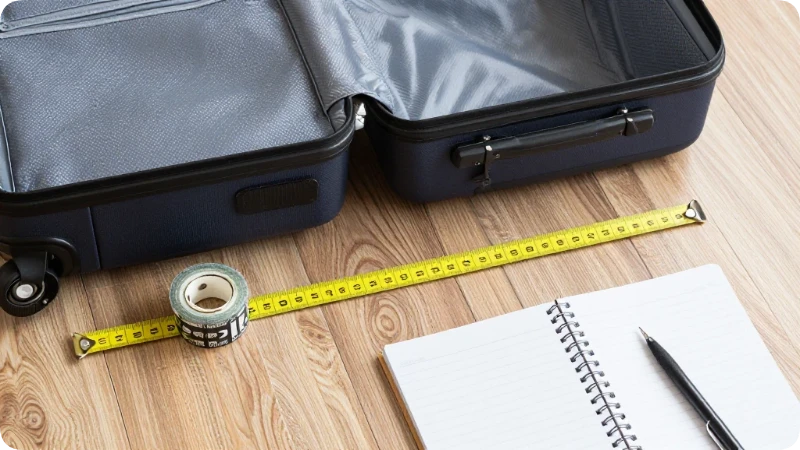
To measure luggage size correctly, add the bag’s length, width, and depth (in cm or inches) with wheels and handles fully extended, then compare that total to your airline’s published linear limit. Measuring the bag empty and un-extended is the single most common mistake travelers make before check-in.
Step-by-step:
- Stand the suitcase upright and extend the handle fully.
- Measure height from the floor to the top of the handle.
- Measure width at the widest point, including exterior wheels.
- Measure depth at the deepest point, including any front pocket bulge.
- Add all three numbers together for the total linear dimension.
- Compare that total, not just the bag’s marketed “size”, against your airline’s limit.
Manufacturer size labels (like “22-inch carry-on”) often measure only the case body, excluding wheels and handles, which is why a bag advertised as compliant can still fail an airline’s sizer.
Packing & Travel Gear Tips for International Trips
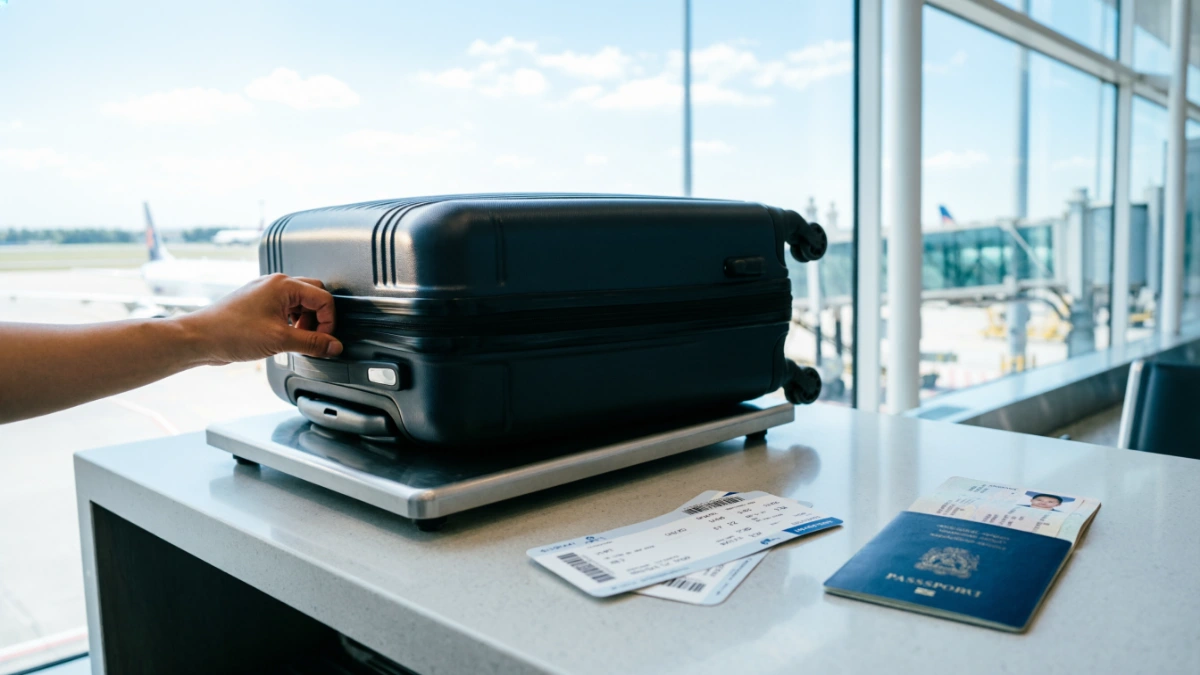
The most reliable way to stay within international luggage limits is to weigh your packed bag at home using a digital luggage scale before you leave for the airport; it takes thirty seconds and avoids the far more stressful (and expensive) alternative of repacking at the check-in counter.
Gear and habits worth adopting:
- A hand-held digital luggage scale ($10-$20) pays for itself after one avoided overweight fee.
- Compression packing cubes free up volume without adding weight, unlike rigid organizers.
- Lightweight polycarbonate or nylon bags (2.5-3.5 kg empty) leave more of your weight allowance for actual belongings than heavier hardside cases.
- Wear your bulkiest items (boots, jacket) through security; they typically don’t count toward carry-on weight.
- Keep eesessential medicationargers, one change of clothes, and valuables in your carry-on in case checked luggage is delayed.
Travel insurance with baggage delay and loss coverage is worth considering on international routes, particularly on multi-airline itineraries where luggage transfers between carriers with different policies.
Common Mistakes to Avoid With International Luggage
The most costly luggage mistakes are assuming one airline’s rules apply to every leg of a trip, ignoring your specific fare class, and measuring an empty bag instead of a packed one, all of which lead to avoidable fees at check-in.
1. Assuming a “carry-on size” bag fits every airline. Fix: check the specific cabin bag limit for each airline on multi-carrier itineraries; a bag compliant on Delta may not be compliant on Qatar Airways.
2. Booking the cheapest fare without checking baggage inclusions. Fix: many Lite or Basic fares include zero free checked baggage; price in the add-on cost before comparing fares.
3. Overpacking one bag instead of balancing weight across two. Fix: on piece-concept airlines, redistribute weight evenly between bags rather than maxing out one and leaving the other empty.
Underrated alternatives: a mid-size 24-inch checked bag paired with a compliant carry-on often beats one oversized 30-inch suitcase; it’s easier to lift, less likely to incur fees, and splits your risk if one bag is delayed.
FAQs
What is the best luggage for international travel in 2026?
The best international travel luggage in 2026 is a lightweight, hard-shell or ballistic-nylon suitcase in the 24-26 inch range, paired with a carry-on that meets your specific airline’s cabin bag limit. Prioritize low empty weight and a durable four-wheel spinner design over size alone.
How big is a 24-inch suitcase?
A 24-inch suitcase measures roughly 61 x 40 x 26 cm (24 x 16 x 10 in) and holds approximately 60-75 liters. It’s classified as “medium” and comfortably clears the standard 158 cm international linear limit.
Do airlines allow 28-inch luggage?
Yes, most airlines allow 28-inch checked luggage, but it sits close to the common 158 cm size limit, so it can trigger oversize fees on strict carriers. Always confirm your specific airline’s per-bag dimension cap before flying with a 28-inch case.
How many kilos fit in 29-inch luggage?
A 29-inch suitcase can physically hold 35-40 kg of packed items by volume alone, but your airline’s weight limit usually applies, 23- 32 kg per bag,s regardless of the bag’s actual capacity. Size and weight limits are separate rules.
Is 28 inches too big for checked luggage?
A 28-inch suitcase is generally accepted for checked luggage, but its total linear dimensions often sit near or slightly over the common 158 cm limit, making oversize fees possible depending on the specific airline and bag shape.
Can you bring 2 bags at 30 kg total for an international flight?
It depends on whether your airline uses the weight concept or piece concept. Weight-concept airlines may allow 30 kg split across two bags; piece-concept airlines typically cap each bag individually at 23 kg, so 30 kg total split unevenly could still trigger a fee.
What is the new size for carry-on luggage in 2026?
There is no single new universal carry-on size for 2026. Most airlines still use their existing limits, commonly 22 x 14 x 9 in for U.S. carriers or 55 x 40 x 20 cm internationally, though gate enforcement has become noticeably stricter with automated scanners.
Should I get a 26-inch or 28-inch suitcase?
Choose 26 inches if you fly a mix of airlines or trips under two weeks, since it stays reliably within most size limits. Choose 28 inches for extended trips or airlines with generous weight-based (rather than strict size-based) checked baggage rules.
Is a 28-inch luggage good for a 23kg allowance?
Yes, an 8-inch suitcase has more than enough volume to hold 23kg of packed items, and weight (not the bag’s size) will be the limiting factor. The bag’s own empty weight, however, reduces how much packing weight you actually have left.
What is the maximum weight for a personal item bag?
Most airlines don’t set a separate weight limit for personal items, folding it into the combined cabin allowance instead, commonly 7-10 kg total across your carry-on and personal item combined. Confirm with your specific airline, since a few do cap personal items separately.
Is 28 too big a piece of luggage for international travel overall?
Not necessarily. 8-inch suitcases fly internationally every day. The risk is airline-specific: carriers with strict 158 cm piece limits may charge oversize fees, while airlines using generous weight-concept rules generally accept it without issue.
What is the biggest suitcase you can check internationally without extra fees?
In most cases, that’s a bag with total linear dimensions at or under 158 cm (62 in) and weight under 23-25 kgkg, roughly a 26- to 28-inch suitcase. Beyond that, oversize and overweight fees typically apply.
Conclusion
Getting luggage size right for international travel comes down to three things: know your airline’s specific size and weight limits, measure your packed bag (not the empty marketed size), and choose a suitcase that fits comfortably inside standard limits rather than pushing right up against them. A 24-26 inch checked bag paired with a compliant carry-on covers the vast majority of international trips without fees or gate surprises.
Airline policies shift by fare, route, and year, so treat any guide, including this one, as a starting point, and confirm your exact allowance on your airline’s official baggage page shortly before departure. Pack smart, weigh before you leave home, and the only thing waiting for you at the airport will be your flight, ot an unexpected bill.

Ben Fogle believes that true adventure begins where the pavement ends. After spending years documenting extreme environments, rowing across oceans, and trekking through frozen landscapes, he mastered the art of wilderness travel. For Travelmarse, Ben constructs highly detailed guides on deep-nature packing lists, wildlife safety, and sustainable eco-tourism. He breaks down intimidating, rugged expeditions into clear, step-by-step roadmaps so everyday travelers can safely connect with the natural world.