A breast milk cooler for travel keeps expressed milk safe between 32°F and 39°F for up to 24 hours, depending on the insulation quality and ice pack type.
The TSA allows breast milk in carry on bags in quantities exceeding 3.4 oz. You do not need a nursing child present. A dedicated cooler bag with a frozen gel pack is the safest, most practical system for any trip.
Pumping and traveling at the same time is one of the hardest logistics puzzles a new parent faces. You’re managing feeding schedules, security lines, delayed flights, and hotel rooms without a freezer all while running on broken sleep.
The wrong cooler setup can mean spoiled milk, wasted pumping sessions, and a very stressful trip.
This guide covers everything you need to know about choosing and using a breast milk cooler for travel, from TSA rules and airport tips to the best bags on the market and the packing mistakes most moms make once and never repeat.
If you’re heading out for a one day work trip or a two week vacation, the right information makes all the difference.
Quick Facts: Breast Milk Cooler for Travel
| Factor | Key Info |
| TSA rule | Breast milk allowed in carry on in any quantity |
| Safe temp range | 32°F – 39°F (refrigerated) |
| Room temp limit | Up to 4 hours (CDC guideline) |
| Cooler bag duration | Up to 24 hours with frozen ice pack |
| Frozen milk allowed | Yes, fully or partially frozen accepted |
| Inspection policy | TSA may test liquid but cannot require you to open it |
| Checked bag option | Yes, but temperature control is less reliable |
Always verify current TSA guidelines at tsa.gov before your trip, as policies can change.
What TSA Actually Says About Breast Milk
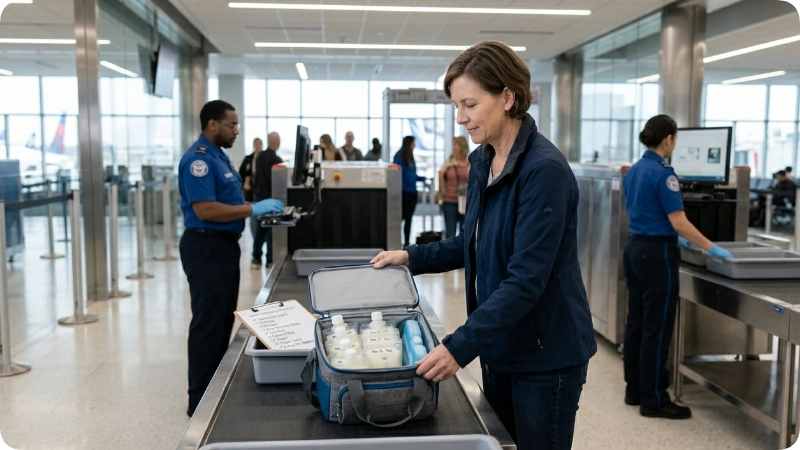
The TSA officially classifies breast milk as a “medically necessary liquid,” which means it bypasses the standard 3 4 1 liquid rule entirely. You can carry breast milk, formula, and juice for infants in your carry on bag in any quantity reasonably needed for your trip. You do not need to have your baby with you at the checkpoint.
TSA officers may ask you to remove the cooler bag from your carry on for separate screening. They may also test the liquid using special equipment, but they cannot require you to taste it, open a sealed storage bag, or transfer it to a different container. If you feel your screening was handled incorrectly, you can ask to speak with a supervisor or file a complaint through the TSA Contact Center.
Insider Tip 1: Declare your breast milk proactively at the checkpoint. Say “I have medically necessary liquids” before placing your bag on the belt. This prevents confusion, speeds up screening, and puts you in control of the conversation.
How Long Does Breast Milk Stay Safe While Traveling?
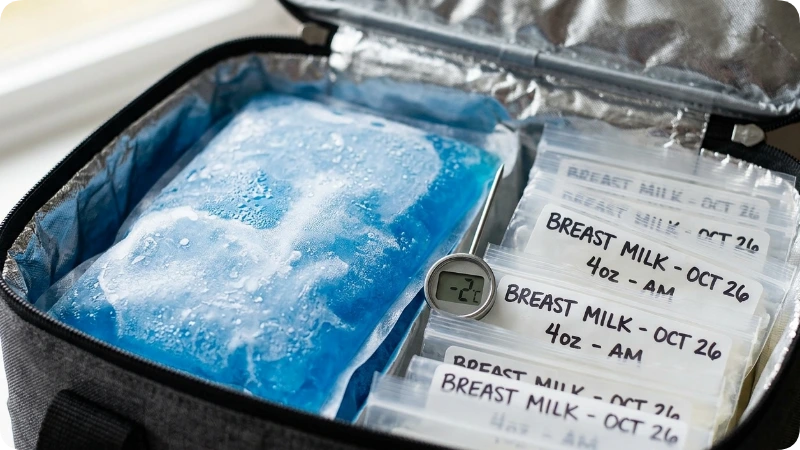
According to the CDC, freshly pumped breast milk stays safe at room temperature (up to 77°F) for up to four hours under ideal conditions. In a well insulated cooler with frozen ice packs, it stays safe for up to 24 hours. Previously frozen milk that has been thawed should be used within 24 hours once it reaches refrigerator temperature.
These timeframes matter more than people realize when you’re in transit. A one hour flight with a two hour delay and a 45 minute ride to the hotel can quickly eat through your safe window if your ice pack isn’t truly frozen. Always start with a fully frozen gel pack, not one that’s simply cold. A hard, fully frozen pack buys you the maximum window.
Insider Tip 2: Freeze your gel packs for at least 24 hours before travel, not just overnight. A half frozen pack loses its effectiveness within a few hours and may not keep your milk cold enough through a full day of travel delays.
The Best Breast Milk Coolers for Travel: What to Look For
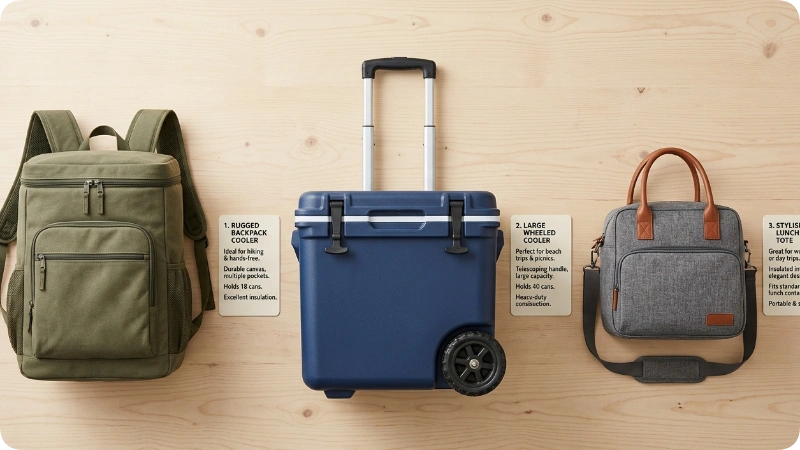
The best travel breast milk cooler balances insulation, size, TSA compatibility, and ease of cleaning. Not every product marketed for this purpose actually performs well under real travel conditions. Here are the features that separate a reliable cooler from one that will let you down at a gate in O’Hare.
Insulation quality is the single most important factor. Look for bags with thick foam walls or vacuum insulation rather than thin foil lined pouches. Foam and vacuum insulation hold temperature far longer, which matters during delays.
Ice pack design is equally critical. Some bags come with reusable gel packs designed to fit perfectly inside the bag, maximizing cold contact with the bottles. Others require you to source your own. Flat, flexible ice packs that hug your storage bags outperform bulky bricks that leave air gaps.
Size and portability should match your pump output and trip length. A bag that holds four to six 5 oz storage bags covers most full day scenarios. If you’re traveling for multiple days, you’ll also need a plan for accessing a freezer at your destination most hotels will store ice packs in their kitchen freezer if you ask at the front desk.
Hidden Gem Products Worth Knowing
Most search results for travel breast milk coolers surface the same two or three mainstream options. These three products fly under the radar but consistently earn high marks from traveling moms.
Medela Breast Milk Cooler Set is not exactly obscure, but most people miss that it’s designed specifically to fit four 5 oz Medela bottles in a perfectly sized ice pack tray. The snug fit maintains a consistent temperature throughout the bag. It’s compact enough to slide into a tote or diaper bag without taking over the space.
Ceres Chill is a double walled, vacuum insulated breast milk chiller built entirely from stainless steel. It keeps milk cold for up to 20 hours without any ice pack at all. Because it uses vacuum insulation rather than a gel pack, it passes through security without the frozen liquid question ever coming up. It holds up to 8 oz at a time and can also double as a supplemental storage container.
PackIt Freezable Lunch Bag deserves mention as a flexible, budget friendly alternative. Its walls contain a built in gel that you freeze solid by leaving the entire bag in the freezer overnight. No separate ice pack to forget, no extra bulk. Many traveling moms use this as their main breast milk transport bag for trips of one to two days.
Atomizer vs. Full Bottle: A Framework for Thinking About Milk Storage
Just as fragrance travelers debate atomizers versus full bottles, pumping moms face a similar choice: individual storage bags versus bottles in a cooler. The right answer depends on your trip length and pumping frequency.
| Storage Method | Best For | Trade Off |
| Breast milk storage bags | Multi day trips, flat packing | Harder to pour cleanly, single use |
| Reusable bottles | Day trips, precise measurements | Takes more cooler space |
| Vacuum insulated chiller (e.g., Ceres Chill) | No ice pack travel | Limited to one session at a time |
| Combination approach | Long travel days | Requires more planning |
For a single day work trip, reusable bottles in a dedicated cooler with one ice pack is the simplest setup. For a four day conference, storage bags in a high performance cooler with a hotel freezer plan makes more practical sense.
3 Tourist Mistakes and How to Fix Them
Mistake 1: Assuming the hotel has a freezer. Many hotel minibars include a small refrigerator but not a freezer. A refrigerator at 35°F–40°F keeps milk safe for up to four days, which is often enough. However, if you need to refreeze your ice packs overnight, call ahead and ask the hotel to store them in their kitchen freezer. Most properties accommodate this request without charge.
Fix: Call the hotel before your trip. Ask directly: “Do the in room refrigerators reach freezing temperature, or can your kitchen staff store ice packs for guests?”
Mistake 2: Overpacking milk for a short trip. Traveling with more milk than you can safely keep cold adds stress without adding safety. For a same day trip, calculate how many ounces your baby needs per feeding, how many feedings will happen while you’re gone, and pack that amount plus one extra feeding as a buffer.
Fix: Use the standard feeding formula (roughly 1 to 1.5 oz per hour away from your baby) to calculate exactly how much to bring. Precision beats anxiety.
Mistake 3: Checking the cooler bag in luggage. Checked baggage holds vary in temperature, especially during tarmac delays on hot days. The FAA has no specific temperature regulations for cargo holds on domestic flights. This creates an unpredictable environment for perishables.
Fix: Always carry your breast milk cooler as a carry on or personal item. TSA explicitly accommodates this, so there is no reason to risk checked bag temperature fluctuations.
Packing Checklist: What to Bring
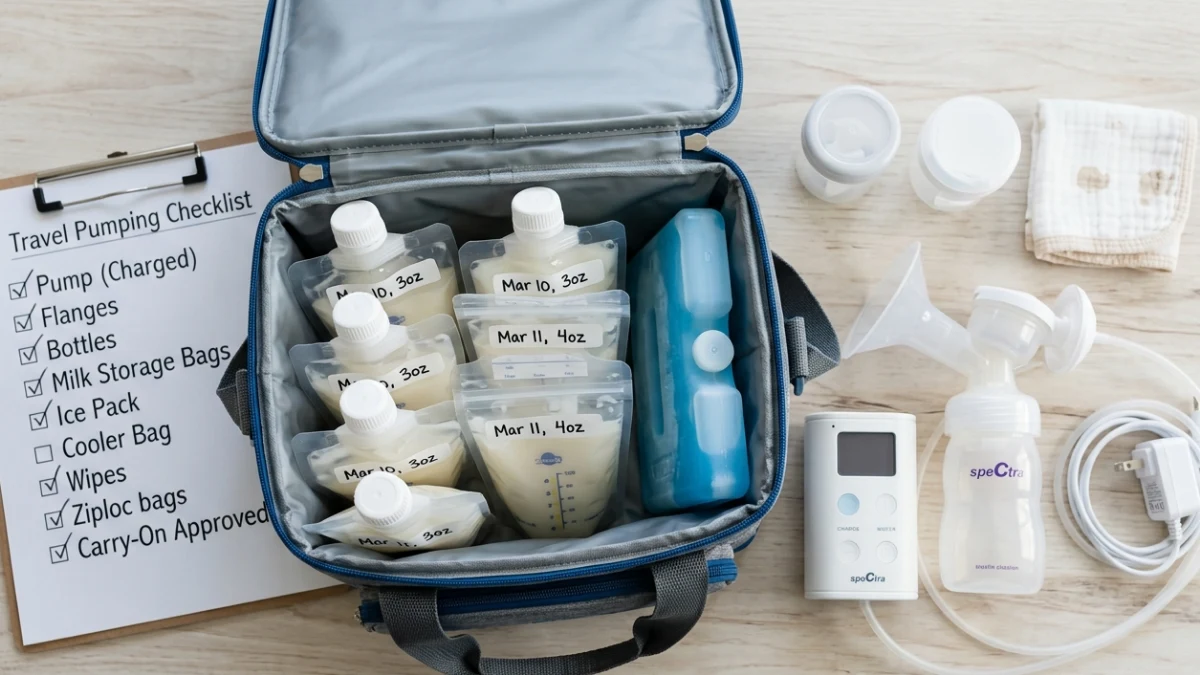
A complete travel pumping kit involves more than just the cooler. Missing one item can derail an entire session, especially in an airport nursing room or a hotel bathroom. Pack everything in a dedicated pouch so nothing gets left behind.
- Breast pump (battery powered or manual saves outlet hunting)
- Breast milk cooler bag with ice pack (fully frozen)
- Milk storage bags or bottles (quantity calculated for trip length)
- Pump parts: flanges, valves, membranes, tubing
- Spare set of pump parts (in case of loss or damage)
- Nursing pads
- Hands free pumping bra
- Small bottle brush and dish soap (travel size)
- Wet/dry bag for used pump parts between washes
- Phone charger (for smart pumps)
- Pen or label tape for dating storage bags
Insider Tip 3: Pack pump parts in a zip seal bag with a damp paper towel between sessions if you cannot wash immediately. This is a method endorsed by several lactation consultants for trips of one day. For longer trips, washing with soap and hot water between sessions remains the safest approach.
Airport Nursing Rooms: What to Expect
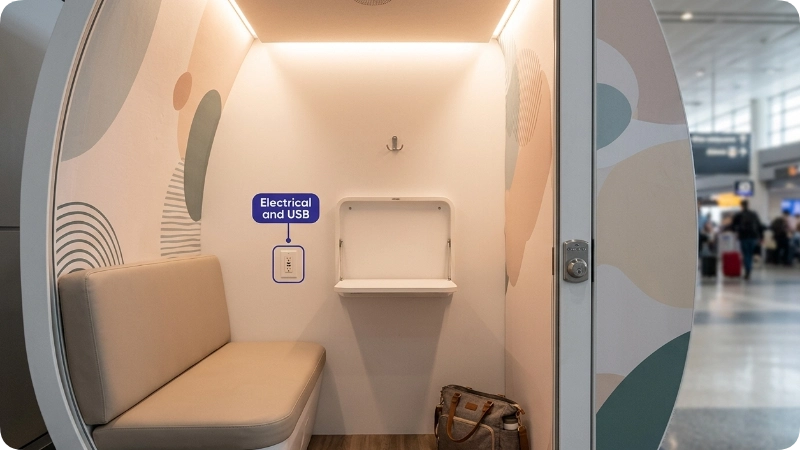
More than 60 airports across the United States now offer dedicated lactation rooms beyond basic restroom nursing areas. The Mamava app provides a map of free standing lactation pods and nursing suites at airports nationwide, updated in real time.
Major hubs including LAX, JFK, ORD (Chicago O’Hare), DFW, and ATL have significantly expanded their nursing facilities in recent years. Most dedicated rooms include an electrical outlet, a fold down surface, and a lock. Quality varies widely, so checking the app before your flight lets you know what to expect and If to build extra time into your schedule.
Insider Tip 4: At airports without a dedicated nursing room, airline lounges often provide a quiet, private alternative. If you hold lounge access through a credit card or airline status, the lounge is almost always a better option than a restroom.
Traveling Internationally with Breast Milk
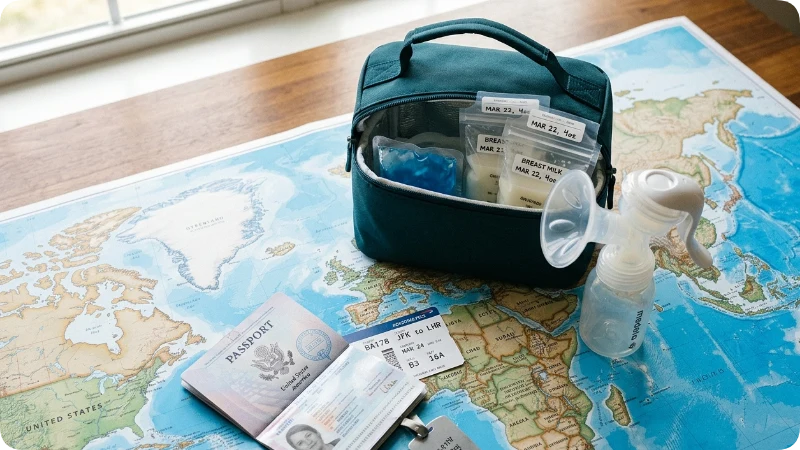
Crossing an international border with breast milk adds a layer of customs and agriculture rules that domestic travel does not. The U.S. Customs and Border Protection (CBP) does not list breast milk as a restricted or declarable item when returning to the United States. However, some countries have their own import restrictions on food products, including dairy.
Before international travel, check the destination country’s customs authority website for dairy or food import rules. Canada, the UK, and EU countries generally have no restrictions on breast milk for personal use. Some countries in Asia and the Middle East have stricter food import policies, so individual research is important.
Insider Tip 5: When traveling with dry ice to keep frozen milk solid on an international flight, note that the FAA limits dry ice to 5.5 lbs per person for carry on use, and it must be in packaging that allows CO2 to vent. Declare it to your airline at check in. Most airlines allow it with advance notice.
3 Underrated Alternatives to a Traditional Cooler Bag
Not every travel scenario calls for a dedicated insulated cooler. These three alternatives solve specific problems that a standard bag cannot.
The hotel ice method works better than many moms expect. A clean zip seal bag filled with ice from the hotel ice machine keeps a separate bag of breast milk cold for several hours. It is not elegant, but it works in a pinch when your ice pack has lost its effectiveness mid trip.
Shipping milk home is a legitimate strategy for longer business trips. Services such as Milk Stork specialize in shipping breast milk home overnight from domestic destinations. The service handles insulated packaging, dry ice, and next day delivery. For a five day conference, shipping milk home each night beats managing freezer logistics at the hotel.
Renting a pump at the destination sidesteps the airport pump question entirely. Breast pump rental services operate in most major U.S. cities, and several travel specific rental programs exist for conference and convention destinations. If your pump is heavy or your bag allowance is tight, this is worth pricing out.
How to Keep Milk Safe During Long Travel Days
Long travel days anything over 10 hours door to door require a more active management strategy than a short commute flight. The 24 hour cooler window sounds generous until a canceled flight extends your travel day by six hours.
Start by layering: place your ice pack on the bottom of the cooler, your milk in the middle, and if possible, another thin flexible ice pack on top. Surrounding the milk on multiple sides slows temperature rise more effectively than a single bottom positioned pack. Avoid opening the cooler more than necessary, since each opening releases cold air.
If your ice pack softens significantly during a long delay, most airport restaurants and bars will give you a cup of ice on request. This extends your cold window long enough to reach your destination safely.
FAQs
Can I bring a breast pump on a plane?
Yes. The TSA explicitly allows breast pumps as carry on or checked items. A breast pump counts as a medical device and does not count against your carry on allowance on most U.S. domestic airlines, though policies vary by carrier. Confirm with your airline before your flight, especially on budget carriers.
How much breast milk can I bring on a plane?
There is no official quantity limit. The TSA allows breast milk “in quantities greater than 3.4 oz” and asks only that it be in reasonable amounts for the trip. You can carry as many storage bags or bottles as your cooler holds. Security officers may ask about quantity, but they cannot confiscate milk that meets the medically necessary liquid standard.
Does TSA have to let me keep my ice pack frozen?
Partially frozen or slushy ice packs are generally allowed, but fully frozen gel packs may draw additional screening attention. If a gel pack is completely frozen solid, officers may test it. Keeping your pack at least partially melted on the surface can speed up screening. Always declare your cooler proactively to avoid delays.
What’s the best breast milk cooler bag for air travel?
The best bag depends on your trip length and pump system. For short trips, the Medela Breast Milk Cooler Set is compact and reliable. For full travel days without freezer access, the Ceres Chill vacuum insulated chiller outperforms gel pack bags. For budget travelers and multi day trips, the PackIt Freezable Bag is the most versatile option.
Can I pump in the airport?
Yes. Many U.S. airports now provide dedicated lactation rooms. Use the Mamava app to find nursing pods and lactation suites by airport. If no dedicated room is available, any private space is legally usable in all 50 states federal law protects a nursing parent’s right to pump in any public or private space.
How do I keep breast milk cold without a refrigerator overnight?
A high quality insulated cooler with a fully frozen ice pack can hold milk cold for up to 24 hours, which covers most overnight windows. For longer gaps, ask the hotel to store your ice packs in their kitchen freezer and refrigerate your milk in the in room mini fridge. Most hotel refrigerators hold between 35°F and 40°F cold enough to keep milk safe for up to four days.
Is it safe to travel with previously frozen breast milk?
Yes, with timing awareness. Frozen breast milk that begins to thaw during travel should be used within 24 hours of reaching refrigerator temperature. It should not be refrozen once it has fully thawed. Plan your travel timeline around this window and pack only the amount you will realistically use within 24 hours of arrival.
Conclusion
Traveling with breast milk does not need to be a source of anxiety. Three things make the biggest difference: understanding your TSA rights so security is never a surprise, choosing a cooler bag that genuinely matches your trip length, and planning your hotel and layover logistics in advance.
The moms who travel most comfortably with breast milk are not the ones carrying the most gear they’re the ones who know exactly what they need, have it packed correctly, and move through airports with confidence because they’ve done the research.
Your milk, your trip, your rules. Pack smart, verify current guidelines at tsa.gov and cdc.gov before each trip, and go.

Maya Lin inspires travelers to explore the globe with absolute confidence and independence. Armed with a background in digital media and a decade of independent solo travel experience, she knows exactly how to navigate unfamiliar cities smoothly and safely. For Travelmarse, Maya curates the solo travel and hidden-gem verticals. She reviews charming boutique hotels, designs smart neighborhood walking routes, and shares practical language-learning hacks, giving readers the exact tools they need to travel solo without the stress.