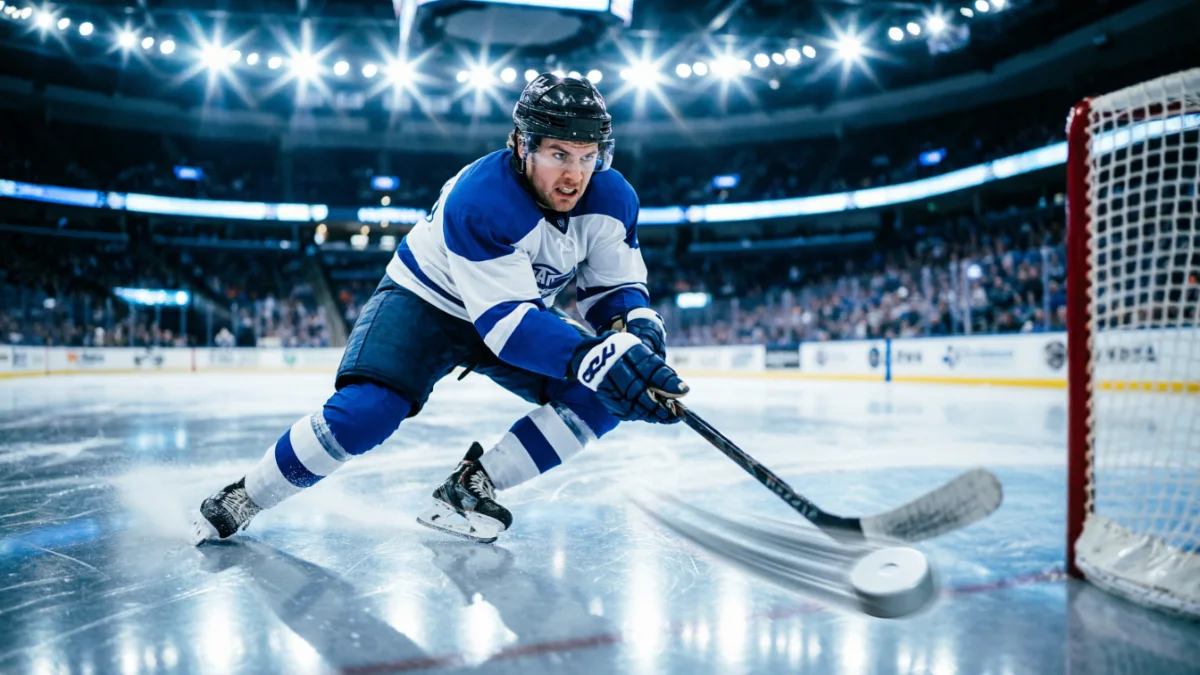
Few sights in sports match a hockey puck rocketing off a stick blade toward the net. How fast does a hockey puck travel? That single question sparks debate in every rink, sports bar, and fantasy league across the country.
This guide breaks down real NHL shot-speed data, puck records, and the science behind the blur, plus dozens of fast facts hockey fans actually search for. If readers plan a trip to a game, coach a youth team, or just settled a bet with a friend, this article delivers clear, verified answers.
From record-setting slap shots to the reason players freeze pucks before every game, this guide draws on official league sources and trusted hockey reporting.
Featured Snippet:
An NHL hockey puck can travel between 90 and 100+ mph during a hard slap shot, and the official record sits at 108.8 mph, set by Zdeno Chara in 2012. Average wrist shots travel 50–60 mph, while everyday recreational shots usually stay under 70 mph.
How Fast Can a Puck Travel in Hockey?
A hockey puck can travel anywhere from 20 mph on a soft pass to more than 100 mph on a hard slap shot. Speed depends on the type of shot, the player’s technique, and the level of play. Wrist shots typically clock in around 50–60 mph, while a full slap shot from an NHL defenseman often exceeds 90 mph.
Recreational and youth players rarely break 60–70 mph, since slap shot mechanics take years to develop. Meanwhile, elite professionals train specifically to add speed through stick flex, weight transfer, and wrist snap.
For context, that means a hard NHL slap shot can cross the width of the offensive zone in under half a second, giving goaltenders almost no time to react.
How Fast Do NHL Hockey Pucks Travel?
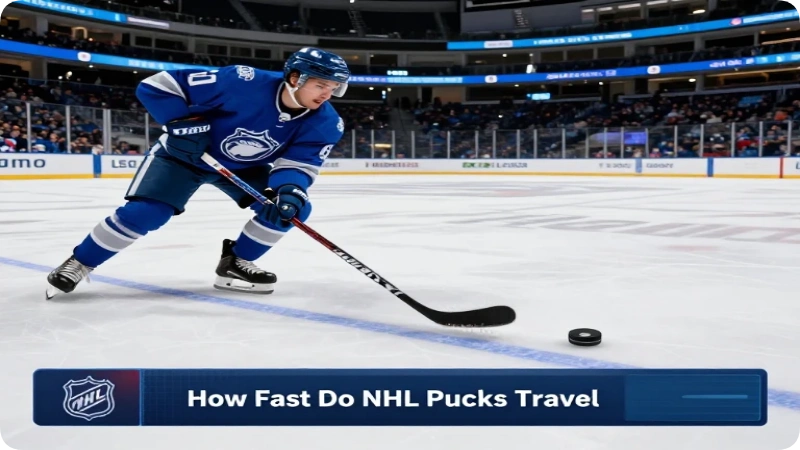
NHL pucks routinely travel between 85 and 100+ mph on slap shots from top shooters, based on the league’s official NHL EDGE tracking system. Wrist shots and snap shots average closer to 55–75 mph. The league tracks every shot’s speed in real time using puck- and player-tracking chips introduced in recent seasons.
During the 2023–24 season, for example, Radko Gudas fired a 101.69 mph slap shot, the fastest recorded shot of that year. Forwards tend to shoot slightly slower than defensemen because defensemen generate speed from farther back with a longer wind-up.
Overall, NHL EDGE data now gives fans live shot-speed numbers during broadcasts, which is part of why the topic draws so much curiosity.
What Is the Fastest a Hockey Puck Has Been Hit?
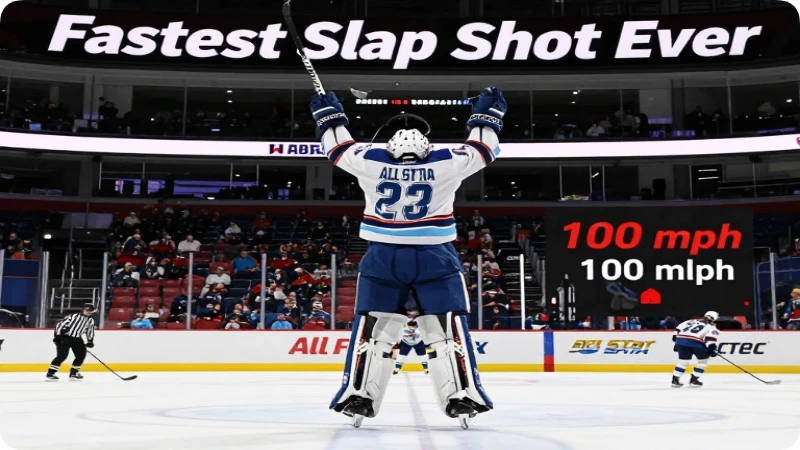
The fastest official slap shot in NHL history belongs to Zdeno Chara, who blasted a 108.8 mph shot at the 2012 NHL All-Star Skills Competition in Ottawa. That mark still stands as the league’s all-time hardest-shot record more than a decade later.
Other notable competition results include Shea Weber’s 108.5 mph shot in 2015 and Martin Frk’s 109.2 mph blast, though Frk’s came at an AHL event rather than an NHL game. Outside official competitions, some claims of shots over 110 mph exist, but those lack the same standardized measurement conditions.
Consequently, Chara’s 108.8 mph remains the benchmark most hockey record-keepers cite as the official fastest puck ever recorded.
Which Is Heavier, a Baseball or a Hockey Puck?
A regulation NHL hockey puck is heavier than a standard baseball. An official puck weighs between 5.5 and 6 ounces (156–170 grams), while a Major League Baseball weighs about 5 to 5.25 ounces (142–149 grams).
The puck’s extra weight comes from its dense, solid vulcanized rubber construction, compared to a baseball’s cork-and-yarn core wrapped in leather. That density is also why a puck feels so much harder on impact than its size suggests.
For comparison, a basketball weighs around 20–22 ounces, while a football weighs about 14–15 ounces. That makes the puck one of the lightest pieces of equipment used in major U.S. team sports, even though it can hit with tremendous force.
Can a Hockey Puck Break a Bone?
Yes, a hockey puck can break a bone, especially at NHL shot speeds. Because pucks are solid vulcanized rubber traveling at 80–100+ mph, an unprotected impact can fracture fingers, hands, feet, or facial bones. That is why players and officials wear specialized padding, and why glass and netting protect fans behind the goal lines.
Notably, several NHL players have suffered broken bones while blocking shots, and legendary shooter Al MacInnis became known for cracking goalie masks and teammates’ equipment during practice. Fans have also suffered injuries when pucks fly into the stands, prompting the NHL to require protective netting above the glass at both ends of every rink after a tragic incident in 2002.
Overall, the risk is real, but modern rink safety nets and player equipment have dramatically reduced serious puck-related injuries since that rule change.
Is Number 69 Banned in NHL?
No, the number 69 is not officially banned by the NHL. However, no player has worn it in league history, largely because of its associations as a sexual innuendo, which teams have chosen to avoid rather than the league formally prohibiting it.
This differs from the numbers the NHL does officially restrict, such as 0, 00, and 99, each of which carries a specific rule. So while 69 remains technically legal, unwritten locker-room norms have kept it off NHL sweaters for decades.
Interestingly, this kind of informal self-policing is common across pro sports, where certain numbers become taboo through tradition rather than written rule.
What Is the Nickname for a Hockey Puck?
The most common nickname for a hockey puck is “the biscuit,” a slang term hockey players and broadcasters use constantly, as in the classic phrase “put the biscuit in the basket,” meaning score a goal. Other informal nicknames include “the rubber,” “the disc,” and simply “the puck” itself, which is already a fairly playful word.
Additionally, some commentators use “apple” for an assist and “cheese” for a highlight-reel goal, showing how rich hockey slang really is. These terms started in locker rooms and broadcast booths and eventually became part of mainstream hockey culture.
For newcomers to the sport, learning this vocabulary makes watching games far more entertaining and easier to follow along with commentary.
Is a Hockey Ball Harder Than a Cricket Ball?
A field hockey ball is generally harder and denser than a cricket ball’s outer material, though both are hard enough to cause injury at speed. A field hockey ball is a solid plastic sphere, while a cricket ball has a cork core wrapped in string and covered with stitched leather, giving it a slightly different feel on impact.
Despite that, cricket balls can travel faster in some situations, such as a fast bowler’s delivery exceeding 90 mph, which offsets the surface hardness difference. Ice hockey pucks use vulcanized rubber and stand in a category of their own. Their high density and potential shot speeds can make them hit harder than either type of ball.
Ultimately, comparing “hardness” across sports depends on both material composition and the speed at which the object travels.
Do They Freeze Pucks in the NHL?
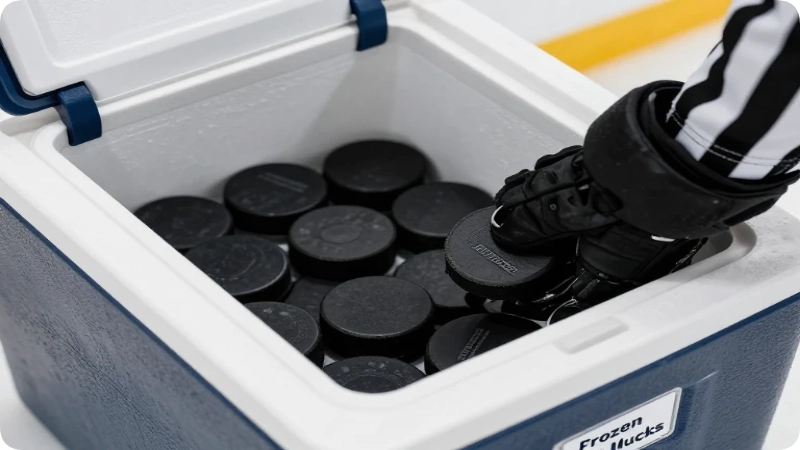
Yes, every NHL and AHL game uses frozen pucks. Officials keep game pucks between 14°F and 20°F in a cooler near the penalty box because freezing hardens the vulcanized rubber and prevents it from bouncing unpredictably on the ice.
A room-temperature puck behaves almost like a rubber ball, bouncing and flipping instead of gliding smoothly, which would make passing and shooting far less predictable. Home teams are responsible for keeping a fresh supply frozen and rotating in about 15 pucks per period, since pucks warm up quickly once in play.
This is why broadcasts sometimes show equipment staff swapping out pucks mid-game, particularly during long stoppages when the current puck has had time to warm back up.
What Do You Call Girls Who Only Date Hockey Players?
The informal slang term some hockey fans use for women who seek out relationships specifically with hockey players is “puck bunny.” It is a colloquial, somewhat dated term rather than an official hockey vocabulary word, and many in the hockey community consider it reductive or outdated today.
Language like this reflects broader sports fan culture rather than anything tied to the game itself, and it appears far less often in modern hockey media than it did decades ago. Readers interested in hockey culture will find plenty of more meaningful terms worth learning, like “biscuit,” “apple,” or “celly” (short for celebration).
Overall, most current hockey commentary and fan communities have moved away from this kind of language in favor of focusing on the sport itself.
Who Is the Wealthiest Hockey Player Ever?
Celebrity wealth trackers widely estimate Wayne Gretzky’s net worth at around $250 million, making him one of the wealthiest hockey players in history. His fortune comes from NHL earnings, endorsement deals, broadcasting work, and business ventures built over decades since his playing career ended in 1999.
Among active and recently active players, Alexander Ovechkin and Sidney Crosby rank among the wealthiest, with celebrity wealth trackers estimating their net worths at around $80 million each. Their earnings come from record-breaking contracts and sponsorship deals with brands such as Nike and CCM. It’s worth noting that these figures are estimates from financial media rather than officially disclosed numbers.
Because most athlete net-worth figures are estimates rather than audited totals, readers should treat any specific dollar amount as an approximation rather than a confirmed fact.
Who Has Hit the Hardest Slap Shot in NHL History?
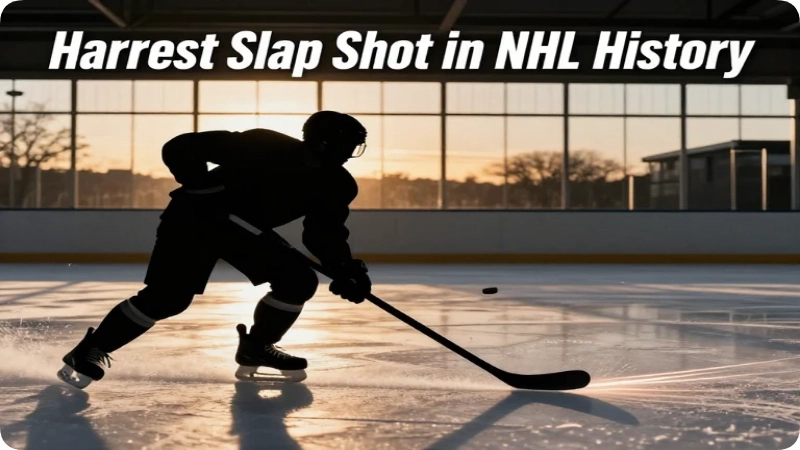
Zdeno Chara holds the record for the hardest slap shot in NHL history, clocked at 108.8 mph during the 2012 NHL All-Star Skills Competition. Standing 6-foot-9, Chara’s height and reach gave him significant leverage advantages over most competitors.
Other legendary hard shooters include Al MacInnis, a seven-time hardest-shot competition winner using a wooden stick, and Shea Weber, who topped the competition in both 2015 and 2016. Bobby Hull, a star from an earlier era, reportedly reached an unofficial shot speed near 118 mph. However, no standardized radar measurement confirms that figure.
As a result, while several names come up in “hardest shot” conversations, Chara’s officially recorded 108.8 mph remains the benchmark hockey record-keepers recognize today.
What Is a Muffin in Hockey?
In hockey slang, a “muffin” refers to a weak, soft shot that lacks any real speed or power, usually one a goalie stops easily without much effort. Players and commentators use it as a light-hearted jab, similar to how basketball fans might describe an “airball.”
The term contrasts sharply with a hard slap shot or a well-placed snap shot, and it often shows up in post-game commentary or locker-room ribbing among teammates. Hearing an announcer call a shot a “muffin” is simply a playful way of noting that the attempt had little chance of beating the goaltender.
Overall, hockey’s slang vocabulary is full of these colorful, self-deprecating terms that make the sport’s broadcasts more entertaining to follow.
What Is the Gretzky Rule?
The “Gretzky Rule” most often refers to a 1985–86 NHL regulation that introduced offsetting penalties, meaning neither team lost a skater when both sides committed penalties at the same time. The league adopted the change specifically because Wayne Gretzky and the dominant Edmonton Oilers were exploiting open ice during 4-on-4 situations to score at an outsized rate.
Some fans also use the term loosely for other Gretzky-linked changes, including a captaincy rule stemming from his famous 1988 trade to the Los Angeles Kings, and the league-wide retirement of jersey number 99 in his honor in 2000. Because people have used the phrase for more than one rule over the decades, context usually clarifies which “Gretzky Rule” they mean.
Either way, all versions of the story highlight just how much influence one player had on how the NHL writes its rulebook.
How Long Do Hockey Pucks Last?
An individual NHL game puck typically lasts only a few minutes of actual playing time before damage, a shot into the stands, or a stoppage removes it from the game. Teams buy roughly 1,500 pucks at the start of each season from InGlasCo, the sole official manufacturer, and an average NHL game can use 25 to 45 pucks across all three periods.
For casual or recreational use, a single puck can last for months or years of practice sessions since it isn’t taking direct 100 mph slap shots every few seconds. Wear mainly comes from repeated impacts against boards, sticks, and skates, which eventually chip or crack the rubber edges.
So while a backyard rink puck might survive an entire winter, an NHL game puck can last only seconds after players drop it for a faceoff.
Has a Hockey Puck Ever Hit a Fan?
Yes, pucks have struck fans in the stands, and one incident led directly to a major NHL safety change. In 2002, a deflected puck fatally struck a young fan named Brittanie Cecil at a Columbus Blue Jackets game, marking the first fan fatality from a puck in modern NHL history.
Following that tragedy, the league mandated protective netting behind both goals at every NHL arena starting in the 2002–03 season. Since then, serious puck-related fan injuries have declined significantly, although pucks can still occasionally clear the glass along the sideboards, where the NHL does not require netting.
This is a good reminder for anyone attending a live game in person: staying alert near the glass, especially in lower-bowl seats, remains a smart safety habit.
How Much Does an NHL Puck Cost?
Teams typically pay a modest wholesale price for official NHL game pucks purchased in bulk from InGlasCo, usually in the single-digit to low-double-digit dollar range. However, the league does not publicly disclose exact pricing. Fans often pay $10 to $25 or more for retail souvenir pucks, depending on team logos, autographs, or special-edition designs. Retail souvenir pucks sold to fans, however, often cost $10 to $25 or more depending on team logos, autographs, or special-edition designs.
Collectible or game-used pucks, especially ones tied to milestone goals or historic moments, can sell for hundreds or even thousands of dollars at memorabilia auctions. Prices and availability change often, so travelers hoping to buy a puck as a souvenir should check current team store listings or the NHL’s official shop before a trip.
Because pricing varies by team, retailer, and collector demand, it’s worth comparing a couple of sources before buying.
Is Hockey a High Risk Sport?
Yes, ice hockey is generally classified as a high-contact, higher-risk sport due to its combination of high skating speeds, body checking, hard shots, and proximity to boards and other players. Common injuries include concussions, shoulder separations, and fractures, with similar levels of severity seen in football.
That said, modern equipment, stricter concussion protocols, and rule changes around dangerous hits have made the sport considerably safer than in past decades. Youth and recreational leagues also apply additional safety rules, such as limiting body checking at younger age levels, to reduce risk further.
Overall, while hockey carries real physical risk, it remains a popular and manageable sport when players use proper equipment and follow current safety guidelines.
Why Are 0 and 00 Banned in Hockey?
The NHL banned jersey numbers 0 and 00 starting with the 1996–97 season because the league’s digital record-keeping database at the time couldn’t properly process those numbers. Marty Biron was the last player to wear 00, doing so briefly for the Buffalo Sabres during the 1995–96 season before the rule change.
Only a handful of players wore 0 or 00 throughout NHL history, including goaltender John Davidson in the late 1970s. Today, NHL rules require jersey numbers between 1 and 98, with 99 permanently retired league-wide.
Occasionally, fans and analysts debate whether the NHL should follow the NFL, NBA, and MLB in reversing the ban, but as of now, the original database-driven restriction remains in place.
Does Gretzky Still Support Trump?
Wayne Gretzky has maintained a public association with Donald Trump for years, including attending Trump’s 2024 election victory party and his January 2025 presidential inauguration. Gretzky has faced criticism, particularly in Canada, over his ties to Trump amid tensions related to trade tariffs and Trump’s comments about Canadian sovereignty.
According to reporting from outlets like Fox News and the Washington Times, Gretzky has largely avoided direct public commentary on Trump’s specific policy statements about Canada, even as his wife Janet Gretzky has responded publicly to online criticism. Trump, for his part, has publicly defended Gretzky multiple times, describing him as a longtime friend.
Because this is an evolving, current political and cultural story, readers wanting the latest details should check recent sports and news coverage rather than relying on any single article for the full picture.
Is Ice Hockey the Hardest Sport?
Whether ice hockey is the “hardest” sport is subjective, but it consistently ranks among the most physically demanding sports in major rankings due to its combination of skating speed, endurance, coordination, and contact. ESPN’s well-known Sports Skills Survey has historically ranked hockey near the top alongside boxing, football, and basketball.
Hockey uniquely combines the balance and technical skill of skating with the physicality of a contact sport, plus fast decision-making at high speed. Other sports, such as boxing and gymnastics, may rank higher for specific skills like pain tolerance or flexibility. The criteria used to judge difficulty can greatly affect the overall ranking.
In short, hockey belongs firmly in the conversation for hardest sport, even if the exact ranking depends on the methodology used.
What Is Lettuce in Hockey Slang?
In hockey slang, “lettuce” refers to a player’s hair, especially long, flowing hair that sticks out from under the helmet during play. Fans and commentators often praise a player’s “lettuce” as a fun, informal compliment separate from actual gameplay.
The term has become a recognizable part of hockey culture, especially around events like “Hockey Hair Contests” that some junior and minor leagues run as promotional fun. It reflects the sport’s playful side, contrasting with hockey’s tougher, more physical reputation.
Overall, “lettuce” is one of many colorful slang terms, alongside “biscuit” and “celly,” that make hockey commentary distinctly entertaining.
What Is Dribbling a Hockey Puck Called?
In hockey, players call quick, controlled puck movements with the stick “stickhandling,” not dribbling, a term more commonly used in basketball. Stickhandling involves using the blade of the stick to control the puck while skating, weaving past defenders, and setting up shots or passes.
Good stickhandling requires soft hands, quick wrist movement, and constant puck awareness, and it’s one of the core skills coaches drill from a young age. Some fans casually say “dribbling” when first learning the sport, but “stickhandling” is the correct and universally used hockey term.
Learning the right vocabulary makes it easier to follow coaching instruction or hockey commentary without confusion.
What Is Slang for Hockey?
Common hockey slang for the sport itself includes “the show” (referring to the NHL, similar to baseball’s “the bigs”), “beer league” (adult recreational hockey), and simply “the ice” as a stand-in for the game or rink. Fans and players also use “the fastest game on Earth” as an informal nickname for hockey overall, referencing its combination of skating speed and puck speed.
Regional slang varies too, especially between Canadian and American rinks, with some terms rooted in specific junior or minor-league cultures. Learning this vocabulary can help new fans feel more at home when chatting with longtime hockey followers.
Ultimately, hockey’s slang culture is one of the richest in professional sports, blending humor with genuine affection for the game.
What Is the Hardest Skill in Hockey?
Many coaches and players consider skating backward while maintaining balance, speed, and puck control among the hardest skills in hockey, since it demands core strength, edge control, and spatial awareness simultaneously. Defensemen in particular must master this skill to keep pace with attacking forwards without turning their backs to the play.
Other frequently cited “hardest skills” include accurate one-timers, in which a player shoots a moving pass without first stopping the puck, and reading the ice at full speed to make split-second passing decisions. Goaltending itself is often argued as the hardest overall position, given the reaction time required against 90-100 mph shots.
Because hockey demands so many overlapping skills at once, there’s no single universally agreed “hardest” one, though skating fundamentals underpin almost everything else in the sport.
Why Do Hockey Balls Have Dimples?
Field hockey balls typically feature dimples, similar to golf balls, to reduce air resistance and improve aerodynamic stability during flight. The small indentations create a thin turbulent air layer around the ball, which actually reduces drag and helps the ball travel farther and straighter when struck hard.
This design choice mirrors the same physics principle used in golf ball manufacturing, where dimples were discovered to significantly improve distance compared to smooth surfaces. Ice hockey pucks, by contrast, don’t need this feature since they slide along the ice rather than flying through open air for long distances.
So while the two sports share a name, their equipment design solves very different physical challenges.
Which Sport Hits the Hardest?
“Hardest hit” can mean different things depending on whether it refers to projectile speed, physical collisions, or striking force, which makes cross-sport comparisons tricky. In terms of projectile speed, badminton shuttlecocks and jai alai balls actually outpace hockey pucks and baseballs, with shuttlecocks smashed over 200 mph in competitive play.
For physical player-to-player contact, football and ice hockey are frequently cited as the hardest-hitting team sports due to full-speed collisions and body checking. Meanwhile, boxing and MMA involve the highest recorded striking forces from a single blow, measured in pounds of force rather than mph.
Because “hardest hitting” depends on the specific metric used, hockey ranks near the top for both puck speed and physical contact, even if it isn’t the single fastest projectile in all of sports.
Why Do Refs Wave Off Icing?
Referees wave off icing, meaning they cancel the infraction and allow play to continue, in several specific situations under NHL rules. Common examples include when the goalie could have played the puck but chose not to, when a defending player could have touched the puck before it crossed the goal line, or during a delayed penalty situation.
Icing also gets waved off automatically if the team that shot the puck is shorthanded on a penalty kill, since the rule exists to prevent teams from stalling, not to punish defensive teams under pressure. The NHL also uses “hybrid icing,” where officials judge who would have reached the puck first based on a race to the faceoff dots, rather than requiring an actual touch.
These nuances often confuse new fans, but they exist specifically to keep the game fair and prevent unnecessary stoppages.
Can You Catch Pucks in Hockey?
Goaltenders are the only players who can intentionally catch or hold the puck with a hand or glove. They use a specialized “catch glove,” also called a trapper, for this purpose. Skaters cannot close their hand around the puck; doing so results in a penalty for closing the hand on the puck.
Goalies also frequently use their blocker or pads to stop and control shots rather than catching every puck, since not every save allows time for a clean glove catch. This distinction is part of why goaltending is considered such a specialized position, requiring different equipment and rules than the rest of the team.
For fans new to the sport, watching a highlight-reel glove save is one of the clearest examples of this rule in action.
Is There a Chip in an NHL Puck?
The NHL has experimented with puck- and player-tracking technology, including embedded chips, as part of its NHL EDGE and previous “Puck and Player Tracking” systems. These chips allow the league to measure real-time shot speed, skating speed, and distance traveled, data that now appears on broadcasts and the league’s stats platforms.
However, the NHL briefly paused an earlier version of tracking pucks in 2021 after players complained the embedded technology affected how the puck slid and performed on ice. Since then, manufacturing improvements have refined the tracking pucks used for shot-speed stats fans see today.
So while not every single puck used in every game contains a chip, tracking-enabled pucks are now a regular part of how the NHL measures things like puck and shot speed.
What Is the Divorce Rate in the NHL?
There is no officially published NHL divorce rate, and no credible league or academic source tracks this statistic specifically for hockey players. General claims about high divorce rates among professional athletes circulate widely online, but they typically apply broad, unverified estimates rather than sport-specific data.
Professional athletes across all major leagues do face unique relationship pressures, including frequent travel, long seasons, and high public visibility, which can strain marriages. Still, without verified NHL-specific research, any specific percentage should be treated as speculation rather than fact.
Readers interested in athlete relationship dynamics should look for peer-reviewed studies rather than anecdotal claims, since this is an area with very little rigorous public data.
What Is Slang for a Bad Hockey Player?
Common hockey slang for a weaker or lower-skilled player includes “pylon” (implying the player is easy to skate around, like a traffic cone) and “turnstile” (suggesting opponents skate right through them defensively). These terms are usually used casually among teammates or fans rather than as formal scouting language.
Other playful jabs include calling a player’s weak shot a “muffin,” discussed earlier, or describing poor stickhandling as “having hands of stone.” While these terms are light-hearted in casual conversation, they can come across as harsh criticism if used toward younger or developing players.
Overall, hockey slang leans heavily on humor, even when describing mistakes or weaker performances on the ice.
Do Hockey Teams Shower Together?
Yes, like most professional and amateur team sports, NHL and other hockey team locker rooms typically include shared shower facilities used by teammates after games and practices, similar to standard practices across professional football, basketball, and other locker-room sports. This is a normal part of team facility design rather than anything unique to hockey specifically.
Locker room culture varies by team and league, and most professional facilities include private shower stalls in addition to open shower areas. This topic sometimes comes up in casual conversation simply because hockey’s locker-room culture is a notable part of team bonding in the sport.
For readers curious about hockey culture generally, team facilities function much like those in other major North American pro sports leagues.
Who Is the Richest Owner of an NHL Team?
According to Forbes’ 2026 rankings, Henry Samueli, owner of the Anaheim Ducks and co-founder of chipmaker Broadcom, is the wealthiest NHL owner, with an estimated net worth in the tens of billions of dollars. Samueli purchased the Ducks from The Walt Disney Company in 2005 for roughly $70 million, a franchise now valued at well over $1 billion.
Other notably wealthy NHL owners include Stanley Kroenke (Colorado Avalanche) and Daryl Katz (Edmonton Oilers), both with multi-billion-dollar fortunes built largely outside of hockey itself. Because most owner wealth comes from business empires unrelated to their NHL teams, these figures fluctuate with broader market and stock performance rather than team success.
Given how quickly billionaire net worths change, readers should check current Forbes or Sportico rankings for the most up-to-date figures.
Who Was the First Hockey Player to Make a Million Dollars a Year?
Bobby Hull is widely credited as one of the first hockey players to sign a contract worth roughly a million dollars, when he jumped from the NHL’s Chicago Black Hawks to the upstart World Hockey Association’s Winnipeg Jets in 1972 with a landmark 10-year, million-dollar-plus deal. That contract was considered groundbreaking at the time and helped legitimize the rival WHA league.
Within the NHL itself, salaries climbed more gradually, with stars like Wayne Gretzky and later Mario Lemieux pushing annual earnings well past the million-dollar mark through the 1980s and 1990s. Today, top NHL players routinely earn eight figures annually, a massive shift from the league’s pre-1970s pay structure.
This history highlights just how dramatically player compensation has changed across the sport’s modern era.
How Do NHL Players Get Paid?
NHL players are paid a negotiated salary under the league’s collective bargaining agreement, typically distributed in installments across the regular season rather than as a single annual lump sum. Contracts can include signing bonuses, performance bonuses, and structured payment schedules that vary by player and team.
The NHL also operates under a salary cap system, meaning each team has a maximum total amount it can spend on player salaries in a given season, which shapes how contracts get structured league-wide. Additionally, players can earn extra income through endorsement deals, appearance fees, and licensing agreements separate from their team contracts.
Because rules around bonuses, cap structures, and payment schedules can change with each new collective bargaining agreement, official NHLPA resources offer the most current details for anyone researching player compensation.
Which NHL Player Is Homeless?
There is no single, verified, current case of an active or well-documented former NHL player being homeless that can be confirmed as an established, cited fact. From time to time, media outlets report on retired athletes across various sports facing financial hardship after their playing careers end, often tied to poor financial planning, injury-related medical costs, or mismanaged endorsement income.
Chris Pronger, a Hall of Fame defenseman, has spoken publicly about how quickly a professional athlete’s earnings can shrink once agent fees, taxes, and lifestyle costs are factored in, though this does not equate to homelessness in his case. Readers should be cautious about specific claims tied to individual players’ personal circumstances unless reported by verified, credible news sources.
If this question stems from a specific news story, it’s worth searching for the most recent, reputable reporting directly, since unverified claims about any individual’s housing situation can spread inaccurately online.
Who Invented the Slap Shot in Hockey?
Credit for inventing the slap shot is genuinely disputed among hockey historians, though Bernie “Boom Boom” Geoffrion is the name most commonly associated with popularizing it in the NHL during the 1950s. Some accounts trace the technique earlier, to players like Alex Shibicky in the 1930s or even to Eddie Martin, who reportedly used a similar shot in Nova Scotia’s Colored Hockey League around 1906.
Geoffrion earned his famous nickname from the loud “boom” sound his slap shot made striking the boards during Montreal Canadiens practices in the late 1940s. Bobby Hull later took the shot to new levels of power and popularity throughout the 1960s and 1970s, further cementing it as a signature hockey move.
Because standardized shot-speed measurement didn’t exist in hockey’s earliest decades, historians rely on newspaper accounts and player testimony rather than hard data to trace the shot’s true origins.
Who Is the Toughest Guy in NHL History?
“Toughest” is subjective and often debated among hockey fans, but names like Bob Probert, Tie Domi, and Georges Laraque frequently top lists of the NHL’s most feared enforcers from the 1980s through the 2000s. These players built reputations largely through fighting and physical intimidation rather than scoring statistics.
From an earlier era, players like Gordie Howe were known for blending elite scoring skill with genuine physical toughness, a combination that earned him widespread respect throughout his career. Modern hockey has moved away from staged fighting, shifting the definition of “toughness” more toward players who absorb heavy hits while still performing at a high skill level.
Because there’s no official statistic that defines “toughness,” these rankings ultimately come down to fan opinion and era-specific hockey culture.
What Is an Apple in Hockey?
In hockey slang, an “apple” refers to an assist, the pass that directly sets up a goal. Announcers and fans often say a player “picked up two apples” to mean they recorded two assists in a game.
The term is part of a broader family of hockey food-related slang, alongside “biscuit” for the puck and “cheese” for a highlight-reel goal placed in the top corner of the net. These playful terms have become so ingrained in hockey culture that they now appear regularly in official broadcasts and league social media content.
Learning terms like “apple” helps new fans quickly follow along with game commentary and postgame stat recaps.
What Is a Nickname for Hockey Players?
Hockey players are often collectively nicknamed “puckheads” or simply “hockey guys” in casual fan conversation, though most nicknames in the sport apply to individual players rather than the group as a whole. Individual nicknames are extremely common in hockey culture, often based on a player’s last name with a simple suffix, such as “Ovi” for Alexander Ovechkin or “Sid” for Sidney Crosby.
Some players earn nicknames tied to their playing style or physical traits, like Wayne Gretzky’s “The Great One” or Bobby Hull’s “The Golden Jet.” This nickname culture is deeply embedded in hockey media coverage, jersey sales, and even team marketing campaigns.
For new fans, learning a star player’s common nickname often makes broadcasts and online discussions easier to follow.
What Does “Biscuit” Mean in Hockey Slang?
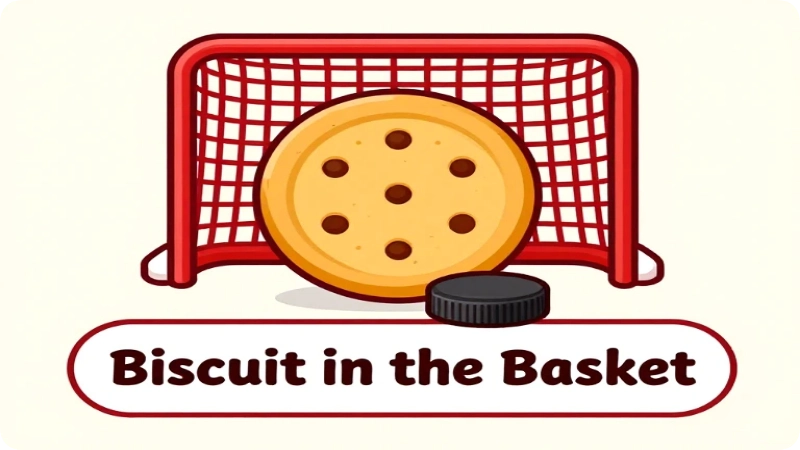
“Biscuit” is one of hockey’s most iconic slang terms, referring directly to the puck itself. The phrase “put the biscuit in the basket” is a well-known way of saying a player scored a goal, combining “biscuit” for the puck with “basket” as playful slang for the net.
This term appears constantly in broadcasts, merchandise, and fan chants, making it one of the most recognizable pieces of hockey vocabulary even to casual sports fans. It reflects the sport’s playful side, offering a lighter contrast to hockey’s tougher, high-contact reputation.
Overall, “biscuit” is a great starting point for anyone learning hockey slang, since it appears in nearly every broadcast and highlight recap.
Quick Facts Table
| Category | Detail |
| Fastest NHL slap shot ever | 108.8 mph (Zdeno Chara, 2012) |
| Average NHL wrist shot speed | 55–75 mph |
| Official puck weight | 5.5–6 oz (156–170 g) |
| Baseball weight (comparison) | 5–5.25 oz (142–149 g) |
| Puck diameter/thickness | 3 in diameter, 1 in thick |
| Puck manufacturer | InGlasCo (sole official NHL supplier) |
| Puck freezer temperature | 14–20°F before games |
| Pucks used per NHL game | Roughly 25–45 |
| Numbers banned NHL-wide | 0, 00 (rule), 99 (retired) |
FAQs
How fast does an average recreational hockey shot travel?
Most recreational players shoot between 40 and 60 mph, well below NHL speeds, since amateur players lack the trained mechanics, stick flex timing, and repetition professionals use. Speed generally increases with age, coaching, and years of practice, especially for slap shots.
Do all NHL rinks track shot speed live?
Yes, all NHL arenas now use the league’s NHL EDGE tracking system, which measures shot speed, skating speed, and other real-time stats using sensors and tracking-enabled pucks. This data appears on broadcasts and the league’s official stats platforms during and after games.
Why does a slap shot travel faster than a wrist shot?
A slap shot generates more speed because the player winds up further, strikes the ice first to flex the stick, then releases stored energy into the puck in one snapping motion. A wrist shot relies more on wrist snap alone, producing less overall force but often more accuracy and quicker release time.
What is the fastest recorded shot by a forward in the NHL?
As of recent NHL EDGE tracking, forwards have recorded shots above 100 mph, with Kasperi Kapanen hitting 101.36 mph during the 2023–24 season, setting a high mark specifically among forwards rather than defensemen. Defensemen still generally hold the top overall speed records due to their positioning and wind-up room.
Is a hockey puck dangerous to catch bare-handed?
Yes, catching a hockey puck bare-handed is dangerous, especially at higher speeds, since the dense rubber can bruise, cut, or fracture bones on impact. Fans attending games should always use caution near the glass and follow arena safety guidance rather than attempting to catch a puck with bare hands.
Do minor hockey leagues use the same puck as the NHL?
Not always. Many youth and minor leagues use lighter, sometimes softer pucks designed to reduce injury risk and match the physical capabilities of younger players. Official regulation NHL-weight pucks are typically reserved for adult, competitive, or higher-level leagues.
How has puck speed changed over the decades?
Puck speeds have increased over time due to advances in composite stick technology, player strength training, and improved shooting mechanics compared to the wooden sticks used through the 1980s. However, some historic wooden-stick shots, like those attributed to Bobby Hull, are still debated as potentially rivaling modern speeds despite less precise measurement tools at the time.
Conclusion
Hockey puck speed sits at the heart of what makes the sport so thrilling to watch, from a routine 55 mph wrist shot to Zdeno Chara’s record-setting 108.8 mph blast. Beyond the raw numbers, hockey’s rich slang, quirky rules, and record-chasing history give fans endless trivia to explore on top of the speed itself.
If planning a trip to catch a live NHL game or simply settling a friendly debate, this guide offers verified, up-to-date answers grounded in official league data and reputable reporting. Next time a puck rockets off the ice, that split-second blur will carry a lot more meaning. Catch a game in person soon, and watch the fastest game on Earth for yourself.

Ben Fogle believes that true adventure begins where the pavement ends. After spending years documenting extreme environments, rowing across oceans, and trekking through frozen landscapes, he mastered the art of wilderness travel. For Travelmarse, Ben constructs highly detailed guides on deep-nature packing lists, wildlife safety, and sustainable eco-tourism. He breaks down intimidating, rugged expeditions into clear, step-by-step roadmaps so everyday travelers can safely connect with the natural world.